Red Touch Yellow

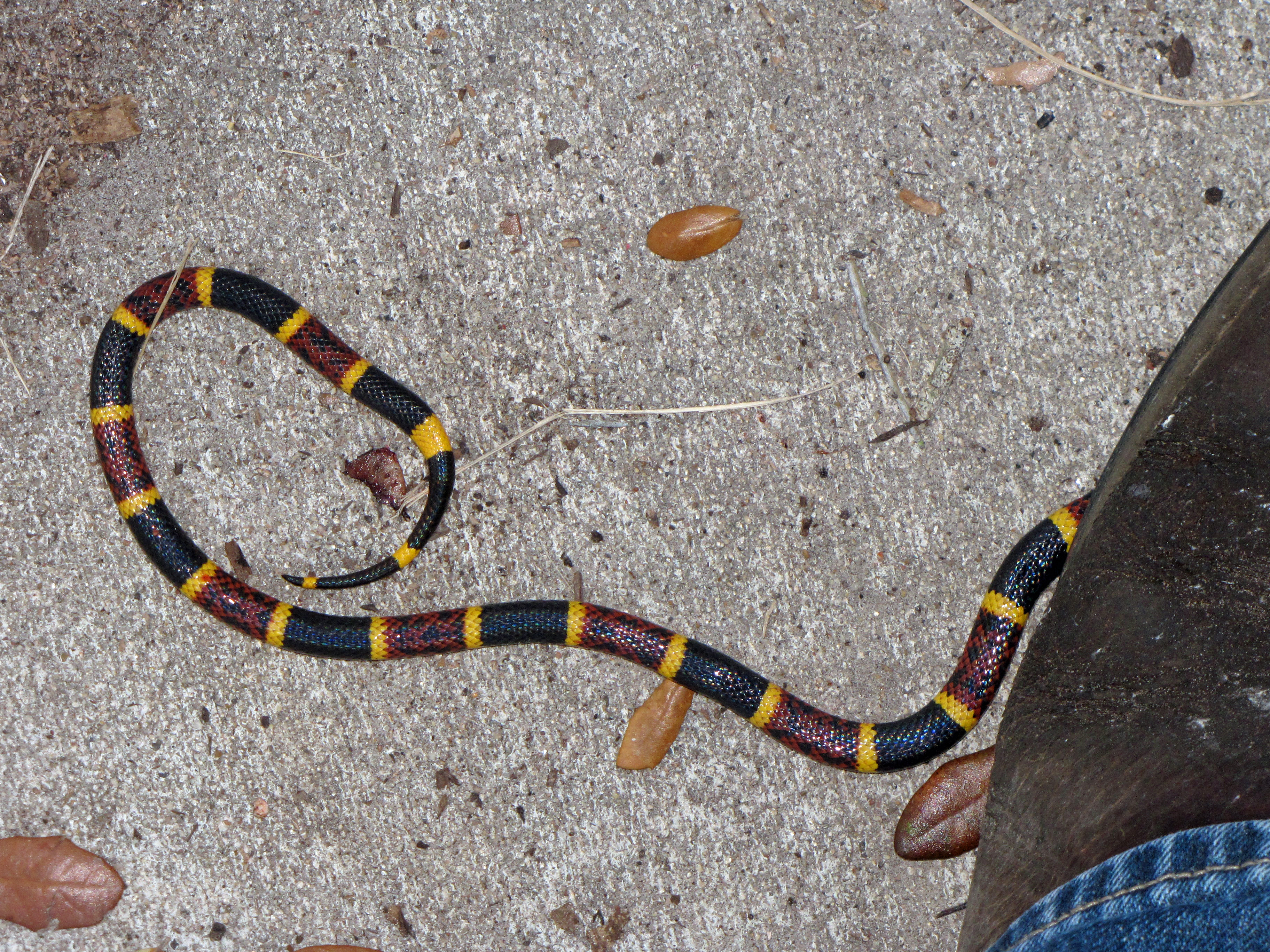
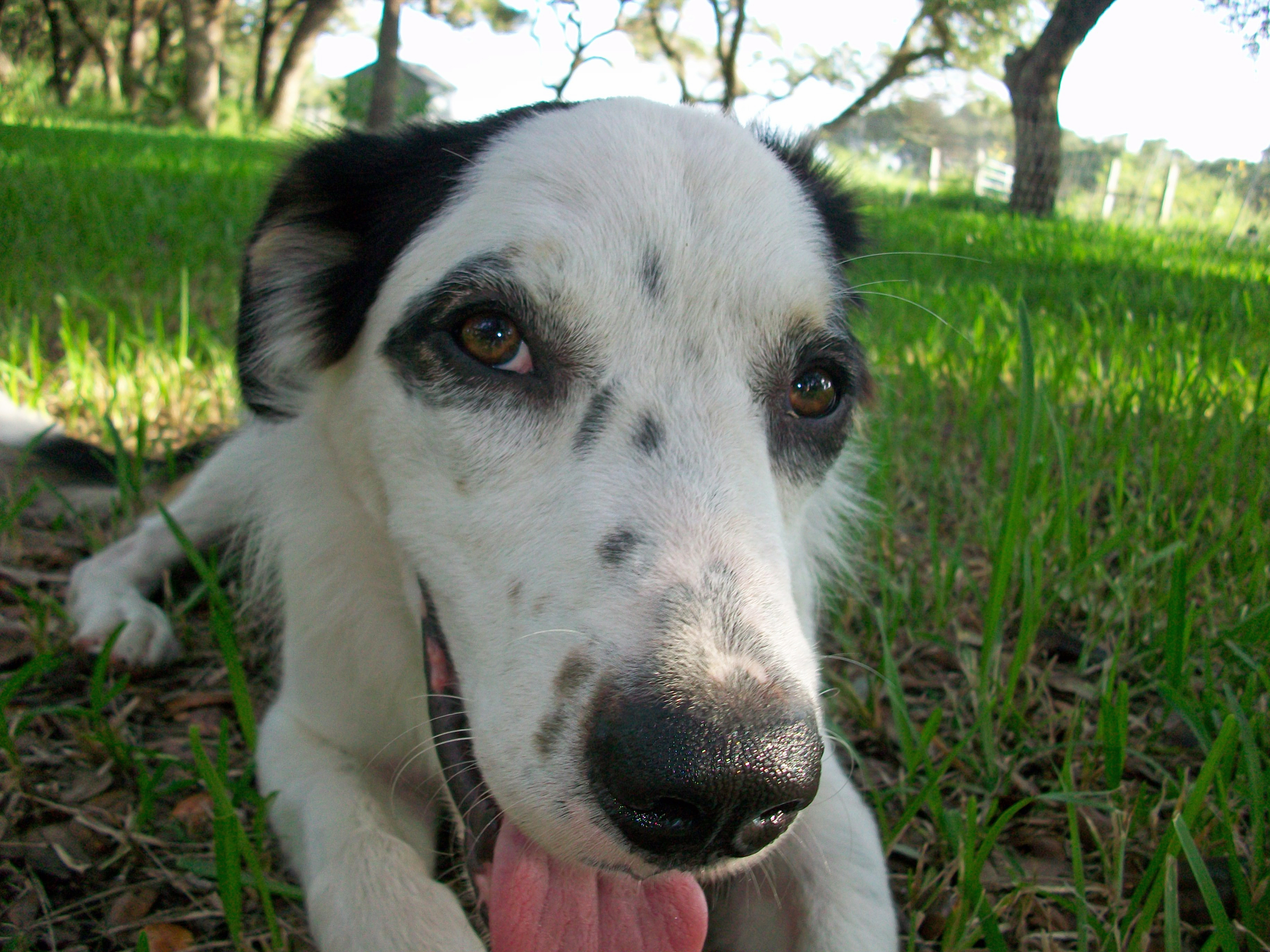
As I knelt among the transplant flats, taking pictures of the green shoots, Bando jumped to my side, and all the hairs on his back went up, and he pushed at me with his trembling body.  He growled the very specific growl that he saves for poisonous snakes.

This is the fifth time—the fifth time—he has jumped at my feet to protect me from a poisonous snake.  When he does this, I stand very still, and look for the focus of his quivering stare, until I see the water moccasin, copperhead, or, in this case, the coral snake, he is warning me about.

Usually, I am able to grab his collar, and pull him backwards, away from the snake, and we take a different path, and let the snake crawl away.

Coral snakes are shy and gentle, and they have tiny fangs, and typically they are not a threat to anyone. But their venom is extremely potent.  A coral snake bite on a dog’s nose would be very bad.

This coral snake was coiled now, less than a step away from me, and striking repeatedly at Bando’s face.  Bando was relentless in his fierce barking, and the snake had turned to attack.

You never have a machete in your hand when you need it.  All I had was the camera, a six-pack of chamomile shoots, and my size 12.5 work boots.

My boot landed instantly, without hesitation, on the striking snake.  I am sorry, coral snake.  I wish you could have crawled away, to live another day.  But under the circumstances, I hope you understand.  You might have done a lot of harm to my good boy, my farm foreman, my little stinker, my faithful friend.

A Lake View

This picture is upside-down.

I love how the water catches every shade of color from the sky:  blue, yellow, purple, white, gray.  I love it when the lake reflects the world like a mirror, like something out of a dream — a quiet morning after a storm.

Good morning, lake.

Burning Toys in Mombasa

Rukia and Justin

The trash piled up in our field pharmacy.  There were no trash cans, no trash bags, nothing in the church for us to put garbage in.

I had been stuffing garbage into my pockets, and piling up empty bottles and boxes behind our table.  As we sorted prescriptions for each patient, stray pills fell onto the table and floor, or into our bins, and there was a growing mess of random pills.

In Kenya, the pills are not labeled with codes, as they are in America, and every pill is the same size and color—round and white.  Unless you took a pill directly out of a marked container, it was difficult to know what type of medicine it was.  The pills looked the same for malaria, or typhus, or ulcers, or pneumonia, or any of a range of other diseases the patients standing in line at our table came to be treated for.

I carefully collected the stray pills into containers and set them to the side and guarded them, to make sure none of our patients were given the wrong medicine.

Someone finally brought a roll of plastic garbage bags, and I filled them with our pharmacy trash.  Rukia, a nurse and translator at the Ushindi Baptist Church, came over and started gathering up the garbage.  I grabbed the remaining trash bags and followed her into the large courtyard of the church.

She dropped the trash into a big pile in the red dirt and said, “Let’s hurry.”

She sprinted across the courtyard.  She wore a brightly colored dress, and she was a stout woman, and seeing her run in that colorful dress was sort of funny.  We entered a long low building with a tin roof.  The small room was soot-blackened and smoky, and there were several large cast-iron pots in the center of the room, next to a fire pit.

She said this was the kitchen, where the meals for the church and boarding school were cooked.  It looked like something out of a pioneer story, nothing but a fire pit and kettles and tin pots, and a single wooden shelf on the wall with a few cooking implements and small bowls.  They cooked meals here for 600 people.

She reached with tongs into the fire and dropped a glowing ember onto a wood chip.

“What are we doing?” I said.

“Come on, we have to hurry,” she said, and sprinted out the door and back across the courtyard, holding the wood chip in front of her and sheltering it with her other hand.

By the time we got back to the trash pile, thirty or forty children were digging through the bags, ripping them apart, pulling out the contents, the empty pill bottles, the packaging, and my boxes of stray pills.

As we approached, Rukia scattered the children with perfectly timed swings of her free hand, her feet sweeping and kicking at the children, her other hand carefully holding the wood chip with the ember.  She was exceedingly good at scattering the children.  She did not land a blow, and I sensed that this was a practiced dance with the children, and they knew how to stay just out of her radius.

The children formed a crowd around us, ten feet back, and watched as Rukia dropped the ember into the center of the trash pile.  She got on her knees and blew the ember until it smoked, and then waved at it with the side of a cardboard box.  A small fire started, and she began to gather the paper and other trash the children had ransacked, and threw it into the flames.  The plastic bags and pill bottles began to smoke, and there was the stinking smell of burning plastic, and then the fire caught and the flames rose and began to consume the pile.

“I’m sorry we had to run,” Rukia said.  “We had to get this trash set on fire fast, or the children would have gotten everything”.

“Why were they getting into this trash?” I said.

“Oh, they would love to have this stuff,” she said.  “They would make toys out of it.  Look at all these pills.  They would eat every one of them.  They would eat them like candy.”

A Recycled Cell Phone

I looked back to the children in a crowd around us.  They watched Rukia push the garbage into the fire with a stick, the boxes and zip lock bags, the packing material, the medicine bottles, the pills.

“There are many things we can save and give to the children, but not this material,” Rukia said.  “They could get very sick if they got into this.”

The trash pile burned down to ash, and the children drifted away to other pursuits.

Rukia said, “Do you do this in the United States, burn your trash?”

“In the United States, they give us huge trash cans,” I said, and held my arms in a circle, “this big around, and this tall, and we put our trash in it, and roll it to the street.  A big truck comes to empty it, and take the trash away.”

“They give you a container, this big, to put trash in?  Who gives you this?” she said.

“The trash company.”

“I would love to have such a container, but not to put garbage in,” she said.  “Oh my Lord, how do you keep the children from digging in the trash?”

How could I explain that in America, most children would not dig through the trash, not even to pull out a perfectly good toy?  I wondered if there was a single child in the entire country who would tear into a pile of trash for food.

“In the United States,” I said, “you can leave the trash out all night.  Nobody will bother it.”

Rude Behavior

“I hate rude behavior in a man.  I won’t tolerate it.”     Captain Woodrow F. Call

I took the trail behind the house down to the barn.  The narrow path is bare from much use.  It is in the shade of scrubby oaks with lush green grass and weeds on either side, morning glories, yaupon holly, yellow coral bean spirals, beautyberry blooming in clusters of purple beads, and sunflowers tall in the patches of light.

I felt a thump against my boot, and looked down to see a fat greenish-black snake in a long straight pose of muscle, connected to my leg, his head throbbing against my boot, his mouth unhooking from my pants.  He coiled himself at the edge of the path and flared his throat at me, the white warning of the cottonmouth.

As much as I do to protect the wild animals on my farm, you’d think a snake would let me go by in peace.  I made an involuntary hop-skip to the side as it happened, and reached under my boot to see if he broke the skin; there was nothing.  The snake crawled into the tall grass.

No harm done.  Enjoy your day, snake.

I finished my work in the barn and came back up the trail, and the same fat water moccasin was curled up at the edge of the path, almost perfectly hidden in the weeds.  If I had not been looking, I would not have seen him coiled in ambush on this path that Bando and I walk a dozen times every day.

As I approached, instead of fleeing into the brush, he flashed his cottonmouthed fangs at me, and released his swamp smell of moccasin, that dank primordial warning.

I hate rude behavior in a snake.  I won’t tolerate it.  That’s that kind of thing that will get your head chopped off.

Stinker Pot Pie

You have to be careful when giving special names.

The name of my farm dog is Bando, but, if he gets into trouble, or does something really clever, I call him Stinker.  I call him Stinker because when my cousin gave me the dog, he said, “I’ve got to warn you, he’s a real stinker.”

Kayla’s dog is named Pressley.  But I needed a good name for her, for when she gets into trouble.  So I call her Stinkerbelle.

When my mom brought over her hyperactive nine pound frenetic rescue dog, Tibbydough, only one name seemed to fit:  Stinker Pot Pie.

When I yelled, “Get over here, Stinker Pot Pie!” at TibbyDough, my five-year-old daughter squealed with laughter.  Of all the times I have heard her laugh, and she is always laughing, I have never heard her laugh so hard.  I said it again, in opera baritone: “Stinker Pot Pie, get off of that table!”  She erupted with laughter.

She laughed so hard she doubled over, and slapped her thigh, and finally, through her giggles, said, “Daddy, you called him a Stinker Pot Pie!”

Here is the problem with giving special names to dogs: they don’t recognize linguistic nuance.  They only catch the first syllable or two of what you tell them.  Now, whether I yell Stinker, Stinkerbelle, or Stinker Pot Pie, all of them straighten up and coming running.

So, Kayla asked me to get everyone together in the car, so we could go on a family outing.  If you have a rambunctious family of people and animals, you know what a struggle it can be to get everyone together to leave.  I took our daughter outside and said, “Get in the car please, Stinker Pot Pie!”

She squealed with laughter and said, “I’m not a Stinker Pot Pie, you’re a Stinker Pot Pie!”

“No, you’re a Stinker Pot Pie!”

“No, YOU’RE a Stinker Pot Pie!”

All of the dogs thought we were yelling at them and came running.  They sat down in a well-behaved line in front of our little girl.

Kayla came out with the bags and said, “Hey! Great job getting everyone together! Let’s go!”

Yes, it’s all part of my grand design.


They Didn’t Mean This for You

A new scientific study recently captured the headlines:  “Why Organic Food May Not Be Healthier for You!”.   

The study claims that conventional produce in the grocery store, for the most part, “does not exceed allowable limits of pesticide residue set by federal regulations.”  Since the main difference between organic and conventional produce is chemical pesticides, the report concludes that conventional food is just as good for you as organic food.    

This report elicited a strong reaction from organic food groups. 

If you buy organic food, please don’t be frustrated by this report.  It was not intended for you.

Meta-Analysis of Bad Science

The report was not a scientific health study, but a meta-analysis; a summation of the findings of 237 other scientific studies. 

Of the 237 studies in the meta-analysis, only 17 were based on health.  And even the 17 health studies had so many problems that most of them should have been thrown out.  Problems with the other studies in the analysis continue to emerge.

As soon as the report was published, it was torn to shreds by scientific peer review.  I’m sure the beleaguered researchers who put the report together will be more careful in the future, considering the wave of scientific scorn that rolled over their findings.

In all fairness to the people who issued this report, they admitted that there were problems with their study, that the findings were not conclusive, and that more research is needed in this area.  But, of course, the disclaimers did not make the headlines.

The Media Doing What They Do

The mainstream media picked up this story because it was good copy.  Food health is a popular topic, and this report was certain to be controversial.  It was issued by a university professor, so it had the aura of scientific credibility.  The story set up a debate with two clearly defined and opposing positions that would happily argue with each other. 

As the two sides went back and forth, the story stretched through several news cycles, and generated a lot of editorial copy.  The report was not good science, but it made a great news story.

The Real Reason for the Report

This study was not meant to convince organic food buyers to switch to conventional; that is not going to happen.  This report was designed to reinforce attitudes among conventional food consumers that their food is safe. 

Conventional food consumers across America, millions of paying customers, constantly hear negative news stories about chemicals and other hidden dangers in their food.  These folks push their carts down the aisles of grocery stores every day, and are just trying to live their lives, and want to hear good news for a change about the food they feed their families. 

This report was meant to give those people a reassuring pat on the back as they reach into the bin for their produce, that the food they put in their cart will not hurt them. 

A news headline like “conventional food just as good as organic” is a simple and powerful message for people who don’t want to think about the “allowable level of pesticide residue” in the food they are eating.

Like I said, this report was not meant for you.


The Last Melon of the Year

Last Watermelon of the Year

Last Watermelon of the Year

This is our last watermelon of the year.

The rest of the melons on this garden space are not quite ready, and will be offered to our animals.  Those unripe melons, the remaining squash and bean pods, the blistered corn cobs clinging to their stalks, and the all the green material in this garden, will be enjoyed by our chickens and porkers.

We must now turn our animals into this garden to prepare the soil for a Fall planting.

Companion Planting with Melons

Three Sisters companion plantings traditionally feature corn, beans, and squash; however, a wide variety of fruits and vegetables grow well in this system, even melons.

The Three Sisters garden in these pictures is a first ever planting on this patch of ground.  To develop a new garden, we first prepare the area, as wild and thick as it is, with chickens and pigs.  The animals eat down all the foliage, brush, weeds, and grass, and fertilize and till the soil.

First Melons, back in June

Next, we plant a Three Sisters garden on that space and harvest everything from it we can.  Then we turn the animals back into that area to consume the remaining green material; the stems and leaves of the vegetables and the remaining produce.  The animals compost the foliage, so to speak, in their bellies, and return those nutrients to the soil as powerfully good fertilizer.

We develop extremely rich soil in this process, and the chicken, eggs, and pork sustained by these gardens become quite delicious.  This method of heritage farming is highly efficient, cost-effective, and sustainable.

A Last Taste of Summer

Melons this late in September feel like a present, a gift of goodness among the tangled green vines.  To me, they are all gifts, these black diamond watermelons that sprang from soil I knew to be wild not long ago.

And this one is a last taste of sweetness, to say goodbye to summer.

The Accidental Killers

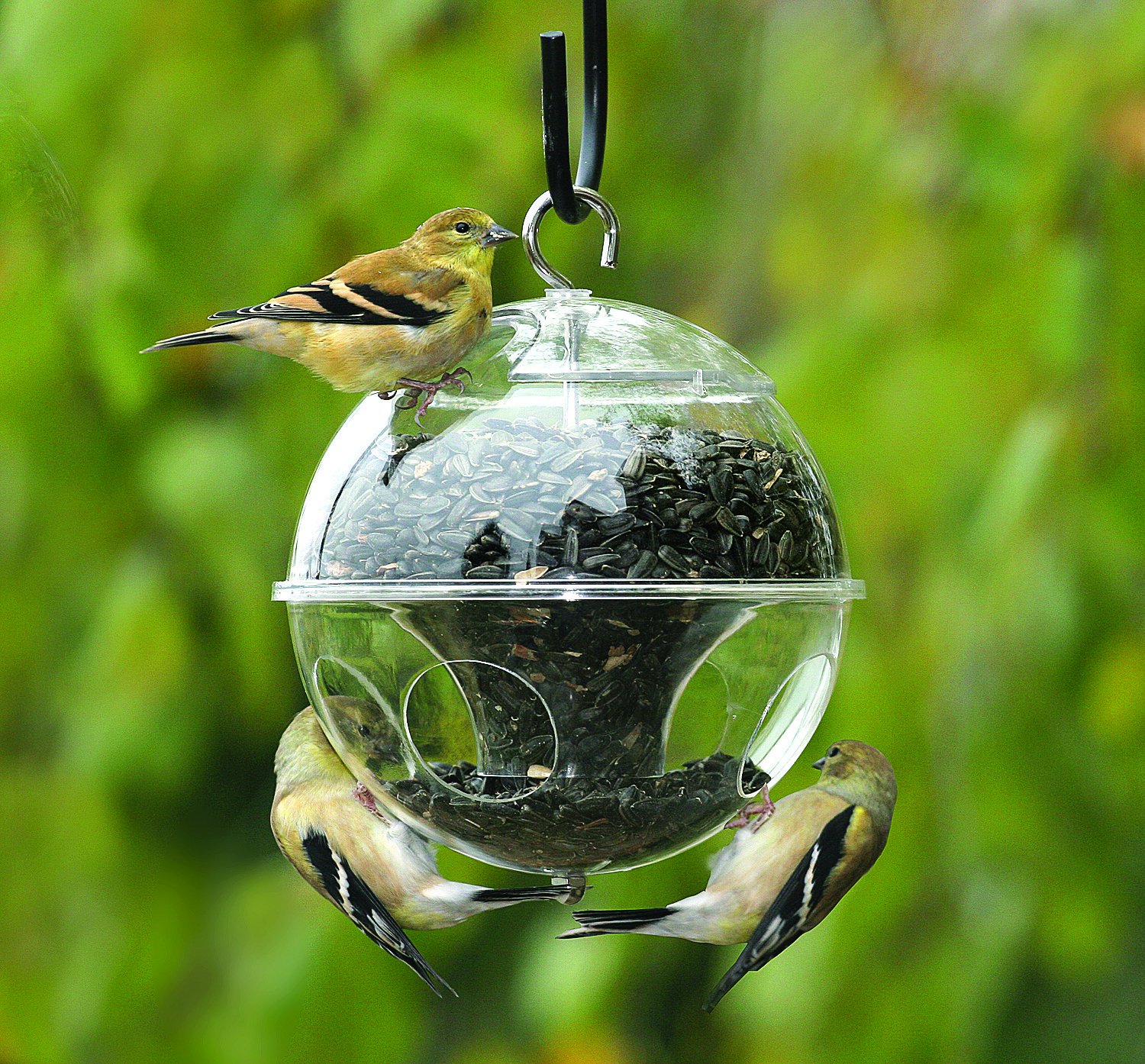
People who feed wild birds are good people.

Have you ever known someone who goes to the trouble to put up a bird feeder in the back yard, and regularly goes out to let down the feeder, or to climb up on a ladder, and add more birdseed, who was not a good person?

This is the kind of person who, when you go to their house, hugs you and makes you feel completely welcome, and probably gives you something good to eat, and insists you come out back and look at all the birds that have come in to the feeders.  You go along, even though you are in a hurry and are not that interested, and when you get out to the yard, your attention focuses more on this person, because of their enthusiasm and excitement for the wild birds, rather than on the birds themselves.

You probably know this person.  You may be this person.

Scotts Miracle-Gro Found Guilty of Poisoning Birds

On a separate note, Scotts Miracle-Gro pleaded guilty last week to illegally applying insecticides to their bird feed that kills birds.  Senior executives at Scotts Miracle-Gro knew that their bird feed killed birds, but they continued to sell it anyway.  They sold 70 million units of toxic bird feed over a two year period before they were forced by the federal government to discontinue the product.

Additionally, Scotts Miracle-Gro pleaded guilty to falsifying pesticide registration documents on a wide range of other products, distributing pesticides with misleading and unapproved labels, and distributing unregistered pesticides.

Scotts Miracle Gro has been sentenced to pay $12.5 million in fines for illegally selling this toxic bird seed, as well as other criminal violations involving their pesticides.

Why Would Scotts Miracle-Gro Intentionally Poison Birds?

Scotts Miracle-Gro added the illegal insecticides to their bird feed to prevent insects from eating the feed in Scotts’ warehouses.  Scotts Miracle-Gro intentionally poisoned their feed simply to prevent a small amount of potential product loss due to insects.

The insecticides Scotts Miracle-Gro applied to the bird feed are called Actellic 5E and Storicide II, and they are prohibited by the EPA.  Scotts admits that they were aware that Storicide II is “extremely toxic to birds, fish, and other wild game,” and still they used it anyway.

The Civil and Criminal Wrong-Doing Includes More than Bird Feed

Not only did Scotts Miracle-Gro sell wild bird feed tainted with bird-killing insecticides, they were also found guilty of submitting false documents to the EPA and state regulatory agencies to deceive the agencies into believing that numerous insecticides were registered with the EPA, when they were not.

Further, Scotts Miracle-Gro also pleaded guilty to selling unregistered pesticides and for marketing pesticides bearing labels that were false and misleading.  These additional violations are not about bird feed, but about products for the lawn and garden.

Scotts Miracle-Gro has been forced to discontinue or recall more than 40 product lines and more than 100 different pesticides.  The $12.5 million fine is the largest criminal penalty issued to date for the illegal use of an insecticide or pesticide.  However, for a company the size of Scotts Miracle-Gro, it is a light slap on the wrist.

Back to the Bird Feeder

There is no telling how many birds were killed by the 70 million units of poisoned feed distributed for two years across America.  One bag feeds a lot of birds.

The people who fed their birds with Scotts Miracle-Gro bird feed actually killed their birds.  They poisoned something they love, by accident.  Nothing was mentioned in the company’s public statements about those people.

But we know, Scotts Miracle-Gro, that you poisoned your product on purpose.  You made accidental killers out of those good people, so you could save a few dollars.

Thank you, Scotts Miracle-Gro, for your commitment to your customers.  We will not forget you.

Homemade Chicken Stock Recipe

Prep Time:  10 minutes

Cooking Time:  8 hours

This chicken stock recipe is simple, flexible, and easy to put together.  For ingredients, we use the remains of our roast chicken, all the bones, the neck and back, and a variety of vegetables and herbs from our garden.  The finished stock is wonderful.

The Secret Weapon

Stock is only as good as its ingredients, and pastured chicken makes excellent stock.  However, the secret of the very best stock is chicken feet. 

Most people recoil from the idea of throwing gnarly old chicken feet into their stock, and I used to feel the same way.  For the longest time, after processing chickens, I saved the chicken feet as a treat for our farm dog.  Bando loves chicken feet. 

However, several of our customers began to request the feet of their chicken to use for stock.  I knew these folks to be really good cooks, so I tried it myself.  Now the dog gets no chicken feet, and the stock gets all the feet.  Sometimes we make stock out of only chicken feet, and it is excellent. 

Left-Over Produce

Making your own stock allows you to control the flavors.  We met a wonderful chef in Mombasa who took all the vegetables and herbs in the kitchen that were past their prime and added them to her amazing stock.  She said the wider variety of vegetables she added, the more complex the taste of the stock. 

The ingredients in our stock recipe are merely a guideline; please feel free to experiment with your stock based on the ingredients you have at hand.  We have added every type of left-over veggies and herbs to our stock, from corn on the cob (cob and all) to carrots, and anything else that grows in our gardens.  After we strain the veggies from the stock, we place them in the compost bin.  But first, we distill from them every last bit of flavor and nutrition.

The Right Concentration of Stock

Your finished stock should be considered “stock concentrate”, and may require a little thinning with water.  Grocery store stock, what most of us are used to, is pretty thin.  Your homemade stock will be much more robust and intense—one cup of your stock will be worth about three cups or more of grocery store stock. 

Thin your stock with water to your desired level of intensity; maybe one cup stock plus two cups water.  We use the sight method (clarity of the stock in a jar) and the taste method (sampling with a spoon).  Try to not eat all the stock during your sampling, as I learned the hard way. 

Ingredients:

  • Skin and bones left over from a roast pastured chicken
  • 2 chicken feet
  • 2 medium-sized onions, peeled and quartered
  • 4 whole garlic cloves, peeled
  • 3 whole carrots, peeled
  • 4 celery stalks, cut in half
  • Various veggies bordering on ruin (we used corn, sweet potatoes, and squash)
  • 2 whole bay leaves
  • Herb bouquet we used thyme, parsley, and dill; sage and tarragon also pair well with poultry
  • Peppercorns
  • Salt

To prepare: Place ingredients in a crock pot and submerge completely in water.  Cook on the low setting of your electric crock pot with the lid on for 8 hours. Or, place ingredients in a cast iron pot, submerge completely in water, and cook in oven with the lid on for 8 hours at 200 degrees.  You may have to add a cup or two of water due to evaporation while cooking.

Many chicken stock recipes call for removing the thin layer of fat that congeals at the top of the stock after it cools.  If you use a grocery store chicken, you should remove the fat.  With this recipe, however, there will be a very small amount of fat (if any) because the chicken is pastured.  If any fat congeals, it is the good healthy fat you want in your diet.  We stir this into the stock and it is great for flavor and health. 

Aftter stock cools, strain vegetables, chicken bones and feet, and herbs, and pour liquid into an airtight container (we like mason jars). Thin with water to desired level of concentration.  Freeze for up to 2 months, or use immediately.  If you freeze the stock in jars, leave a little head space so the stock can expand as it freezes.

Nutritional Information

We are not able to provide accurate nutritional information because there are so many variables in this recipe.  The amount and type of produce, herbs, and chicken parts will vary widely, and also the final concentration of stock will vary according to taste.

Good chicken stock is as healthy as its ingredients.  When we make stock from the chicken and vegetables and herbs we grow on our farm, we know there are only good things in it, and we feel free to use as much of it as we like. 

By using chicken feet, your stock will be much richer in collagen, calcium, glucosamine chondroiten, and other essential minerals.  The health benefits of adding chicken feet to the stock are as great as the taste benefits.

More about Chicken Stock: 

A good stock adds richness, depth, and flavor to the dish.  However, a mediocre stock can diminish, rather than enhance, your dish.  If you are going to the trouble to prepare an excellent meal, it’s worth it to have a good stock on hand. 

The supposed benefit of grocery store chicken stock is that it is easy and inexpensive.  The negatives of grocery store stock are the taste and health properties.   You will never find a stock in the store as good as what you make in your own kitchen. 

To that end, the stock you make in your kitchen will definitely be cheaper than grocery store stock, because you are using items already at hand.  Even better, you can use chicken parts and produce that would otherwise be thrown out, and get a lot of value from them first.  And it takes about the same amount of time to prepare your own stock as it does to wheel the cart down the grocery store aisle and reach for a container of stock (not counting the overnight simmering—but hey, the crock pot didn’t have anything better to do).

Good chicken feet can be hard to find.  The best way to get a good supply of feet is to call your local farmer and reserve them.  Ethnic grocery stores or markets sometimes carry them. 

When you get the feet, you can throw them into the stock exactly as they are.  You do not need to remove the outer skin from the feet, or cut off the toe nails.  One of our wonderful customers told me she clips the nails of the chicken feet, so they appear more aesthetic in the cook pot.  But there is no need to pedicure your chicken feet, just throw them in the pot and put on the lid.

Making It

The Crucified Land, by Alexandre Hogue

The Crucified Land, by Alexandre Hogue

The paintings of Alexandre Hogue came to town.  Hogue was the Dust Bowl painter of the Great Depression.  Someone at the museum has a dark sense of humor, to show those paintings around here.

Still, Kayla and I packed our picnic basket, to stay within budget, and went down to the museum to look at the paintings.

Houge depicted the soil erosion of 1930’s industrial farming, and the ensuing dust storms that transformed the landscape.  He painted the failed farms of the Great Depression.

In The Crucified Land, a muddy ditch opens in the foreground of the painting and rips gashes out of the field.  The vertical rows of the crops point to the tractor.  Hogue blamed the machinery of corporate farming for devouring the soft crust of the earth and throwing the crumbs to the wind.

There are no people in the Dust Bowl paintings.  The people on the farms did not make it.

My great-grandpa would tell of the Depression.  They ate fried eggs every day, and homemade bread; there was nothing else.  How could he explain it to children?  It was the unreality of history.

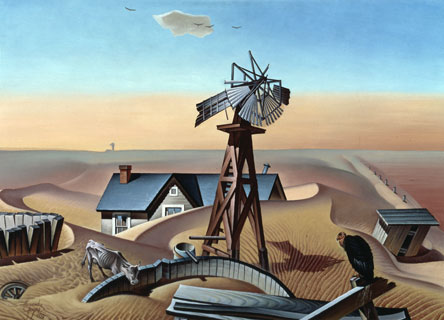
Drought Stricken Area, by Alexandre Hogue

Houge told it this way:  A busted windmill stands in front of a house.  The house is buried in the dust of a thousand farms. A cow stares into an empty trough.  A buzzard waits for the cow to finish dying.  The texture of Drought Stricken Area is red grit sifting from the canvas into your shoes and behind your neck and down your throat as you stand in the museum and look at it.

If you kept great-grandpa talking about the Depression, he would tap his cane on the porch and smile and tell of their little escapes:  the cinema in Shiner; picnics beside the green river.  Not everyone made it, he said; we made it.

I started my farm business four years ago; the first year of this drought, the first year of the recession. The drought has changed the ecology of the land. The recession reset the context.

I wonder what Kayla will tell our great-grandchildren of now, of this time. Even if I live to be old, I probably will never meet them; but Kayla will. I wonder if she will tell about the exquisite irony of fried eggs and toast.

We need a new painter, to help her tell it.  We need a painter for this time, this recession, this drought.

The new painter will show Kayla in her red dress, after church, standing in the garden, about to pick a watermelon.  The light is from the top, harsh sunlight.  Her dress is defiantly red against the papery brown corn stalks and her hair is up in braids.  Behind her, sunflowers grow in a thick hedge, tight gray-green vertical lines, 20 feet tall, and no yellow flowers at the tops.  Nothing moves in the heat of the painting, not the corn stalks or sunflowers, not the lizards in the sand, not the alligator eyes in the lake, nor the hawk in the distant tree.  Only the woman moves as she reaches down with both hands for one sweet thing in the ravaged landscape.

Another painting will show a garden of freshly tilled black soil.  The long rows form horizontal lines in the foreground that run parallel up the painting, shrinking into the distance.  The lighting is indirect from the left, morning light, the sun behind the trees.  The sky is pale blue, the clouds over the Gulf pink and golden in their billows.  The eye climbs the garden rows like steps into the far distance, to the shape of a woman, tiny, with her hair up in braids.

If you look closely at the painting, close enough for a security guard in the museum to clear his throat, you will see that the woman is kneeling beside the first row.  Sacks of seeds surround her, and she pushes each seed into its place in the soil, and shifts herself down the row.  The painting cannot show the light move from the left to the far right, the rich mauves of sunset draping the distant trees.  The woman has worked all the way down the garden to the foreground of the painting.  She is now perfectly clear, filling the frame, the center of the composition, still planting seeds, injecting life with her fingers, life to the painting, life to the world.

I wonder if she will tell our great-grandchildren about our picnics; how she carefully laid out the food we grew on a blanket; how we ate till we were full; how she rested her head on my shoulder and we slept outside the museum in the shade of an oak tree.

I wonder if she will tell of the museum–our escape. If she will tell how I stood to the side at the Hogue exhibit and watched her move down the line of paintings, savoring each one, more beautiful than each one.

I wonder if she will tell that we made it.