Nature’s Most Charming Pesticide

Lady Bugs Go Where They are Needed

Lady Bugs Go Where They are Needed

Most of us recognize the softer side of lady bugs, their iconic spots, and their delicate beauty.  But lady bugs have an aggressive side, a ravenous appetite, and even their bright colors serve as a warning.  Lady bugs are lovely, but they are also ferocious predators.

Lady bugs have sideways-facing jaws like tiny steel traps.  They use these powerful jaws to devour hundreds of aphids every day.  Aphids are a terrible garden-destroying pest, and a single lady bug can eat more than 5,000 aphids in her lifetime.

Lady bugs lay their eggs in yellow clusters on the undersides of leaves.  When the eggs hatch, the babies look nothing like lady bugs, but more like tiny black and orange alligators that scurry across the leaves.  These voracious larval lady bugs eat their full weight in aphids every single day as they grow into adults.

Lady Bugs

Lady Bugs

When threatened, lady bugs emit a foul-smelling fluid from their leg joints.  This toxic secretion, called hemolymph, repels predators.  The fiery colors and bright spots on a lady bug’s back are nature’s way of warning enemies that lady bugs are bad to eat.  Even the eggs and larva of lady bugs are poisonous to predators.

Typically, the only thing that kills lady bugs is chemical pesticides, which can’t distinguish between good bugs and bad.  Unfortunately, pesticides kill lady bugs in their adult as well as their egg and larval stages, so one spray could destroy all the current and potential lady bugs in the garden.  Aphids, on the other hand, are more pesticide-resistant, and aphids reproduce a new generation every week.  Without lady bugs to control them, aphids can quickly do enormous damage to your vegetables.

To bring lady bugs to your garden, you can order them over the internet.  An insectary will ship a package of living adult lady bugs to your mailbox.  Release a few of these lady bugs into the garden each evening at dusk, and store the rest in the refrigerator.  If you release the lady bugs all at once, they will swarm into the air and fly straight back to the insectary where they were born, like homing pigeons.

Before releasing them each evening, water your garden and spray a little liquid molasses onto the leaves.  This sugary energy will help your lady bugs get started.  Re-seed lady bugs into the garden several times until a native population establishes itself.

Lady bugs love the nectar of flowers, and they especially need nectar when laying eggs.  Plant flowers generously among your vegetables:  Queen Anne’s lace, nasturtiums, cosmos, marigolds, and sunflowers.  Plant basil, dill, and cilantro between your vegetables, and let them go to flower.  Lady bugs especially love the flowers of bean and pea plants.

Lady bugs are adorable, but they are also voracious predators.  They sweetly go about their business of devouring your garden pests.  Lady bugs have a well-earned reputation as the gardener’s good friend, and they are nature’s most charming pesticide.

Lady Bugs on Pest-Damaged Leaf

Lady Bugs on Pest-Damaged Leaf

The Skin of a Toad

Toads Burrow Deep into the Soil During the Day, and Come Out at Night to Hunt

Toads Burrow Deep into the Soil During the Day, and Come Out at Night to Hunt

Toads are among the least attractive of our garden friends.  They have been unpopular since the day a sassy princess was ordered to pucker up and kiss one on the thin green lips.  But don’t let their frowning faces fool you–toads are a powerful ally in the garden.

A toad can eat up to a thousand insects in a single night:  caterpillars, slugs, beetles, ants, mosquitos, and flies.  Toads capture these insects by snatching them with their long sticky tongues, and even using their front feet to shove larger bugs into their mouths.

Toads eat with their mouths, but toads drink water through their skin.  This process, called cutaneous absorption, is why you see toads sitting in pools of water, but never see them drink.

Toads have pockets of glandular toxins on their skin that look like warts.  These toxins are a self-defense mechanism against predators, and can even be fatal to coyotes, foxes, and raccoons.  This poison is the reason the witches in Shakespeare’s play first threw a toad into the cauldron to cast their wicked spell.

Toad Coming Out of Burrow at Sunset

Toad Coming Out of Burrow at Sunset

Because of this amazing skin, toads are tough and extremely resilient.  But there is one thing that will absolutely kill a toad:  chemical pesticides.  Because of cutaneous absorption, toads are forced to drink chemicals through every pore of their skin, and it is fatal.

When toads are killed, it takes a long time, sometimes years, for them to repopulate and help in the garden.  Unfortunately, the insects that toads would have eaten reproduce in a matter of weeks, or even days, and grow out of control.  That is one the reasons pest problems tend to return after a spray of chemicals, and even worse than before.

To attract toads to your garden, plant your vegetables intensively so the leaves grow together and form a thick canopy over the soil.  This canopy provides cover and protection for toads and other beneficial predators.  A dense planting of flowers nearby also provides an excellent sanctuary, even when the vegetable garden is bare.

Also, place a few shallow pans of water in your garden, flush with the level of the soil, so toads can easily climb in and out to drink.  On our farm, we place these pans beneath our drip irrigation lines, down the center of each row, so the pans are refilled every time we water the garden, and the toads are drawn to our vegetable crops.

Protecting your toads is simply a matter of economics:  A single South Texas toad can eat more than 30,000 bugs during the summer.  A few toads in your vegetable garden will eradicate hundreds of thousands of insect pests that you will not have to treat.  Toads save a lot of money, labor, and produce.

It is true, toads are not particularly attractive.  But you will rarely even see them; and unless you are a hopeful princess, you will certainly never have to kiss one.  Toads do their work in the dark of night; hunting beneath their canopy of leaves and flowers; drinking water through their skin; and busily eliminating pests from your garden.

Toad Going out at Dusk to Hunt.  Toads Eat up to 1,000 Bugs Every Night!

Toad Going out at Dusk to Hunt. Toads Eat up to 1,000 Bugs Every Night!

A Trampoline for Chickens

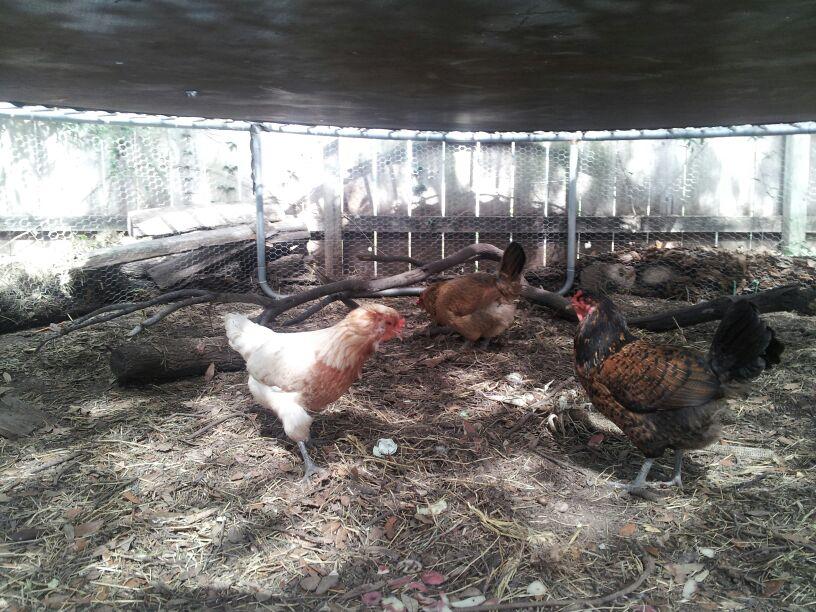
Chickens under a Trampoline with a Ladder to Nest Box

Chickens under a Trampoline with a Ladder to Nest Box

My cousin, his wife, and their nine-year-old twin girls love farm fresh eggs.  They drove out to the farm so many times for eggs, that we finally just gave them their own hens.  We put three big chickens in a cardboard box, closed the lid, and all they needed to do when they got home was to build a chicken coop.

City ordinances in their town allow backyard hens, and the only requirement for the chicken coop is that it be no more than five feet tall.

When designing your own chicken coop, the best plan is to keep it simple.  All that chickens really need is a roof to protect them from rain and sun, and some kind of fencing to keep the chickens where you want them.

My cousin’s twin girls are creative, intelligent, and absolutely adorable.  They named their hens Chick-Chick, Cluck-Cluck, and Janet.

When they got home, the girls engineered a very clever solution to house their hens:  they converted their trampoline into a chicken coop!

Chick-Chick, Cluck-Cluck, and Janet

Chick-Chick, Cluck-Cluck, and Janet

First, they neatly attached wire fencing around the posts to keep the hens inside.  The jumping part of the trampoline served as an excellent roof.  They made a simple nest box with a door in the back to reach in and collect the eggs.  For a roosting perch, they used a fallen oak branch, perfect for the hens to climb on.  And for bedding, they used their own raked-up leaves.

The coop is light enough for my cousin to easily move around the yard, so the hens have continual access to fresh grass.  Or, they can leave the coop on the garden to prepare the soil for the next planting.  The coop is neat and tasteful, and the neighbors have no idea there are chickens underneath.  And best of all, the twins can still play on their trampoline, with the hens nesting peacefully below.

A Very Respectable Nest Box

A Very Respectable Nest Box

Easy Access to Eggs

Easy Access to Eggs

For most people, the challenge of the chicken coop is the main obstacle to keeping backyard hens.  But chicken coops are easy.  If you don’t have a trampoline, you can search the internet for endless examples of inexpensive chicken coop ideas.

If you have a more upscale taste in chickens, Neiman Marcus sells a luxury chicken coop for the low, low price of $100,000.  Or, Williams-Sonoma can ship you a chicken coop on wheels for only $1,500.  The trendiest chicken coops in Texas compete in the Austin Funky Chicken Coop Contest, and you can vote for your favorite.

Still, I think the chicken trampoline wins the prize for ingenuity, functionability, and hilarity.  The next time I visit, I won’t be surprised to see the twins, and the hens, all jumping on the trampoline together, everyone having a great time, and I don’t think it will hurt the eggs one bit.

(All photos on this post courtesy of two very clever little girls!)

Happy Chickens

Happy Chickens

Fresh Eggs Daily

Fresh Eggs Daily

A Gardening Class this Sunday, plus Much More!

Intensive Successive Companion Planting

Intensive Successive Companion Planting

Friends, please join me this Sunday, June 23, from 4:00pm to 6:00pm, for a summer gardening class.  The class will be held at the First Baptist Church in Rockport, at 1515 N. Live Oak Street, Rockport, TX 78382.

This event is free and open to the public.  Our class will be held in the shade!  Bring a lawn chair, a hat, and a passion for wholesome food!

At this class, we will focus on:

1)  Preparing the garden from scratch

2)  What to plant now in the hottest weather

3)  The basics of “Intensive Successive Companion Planting”

Gardeners of all ages and skill levels are welcome. Even if you have never planted a seed, you will go home with the knowledge to start your own successful garden.

Moore than Feed of Rockport is graciously sponsoring this gardening class, and we will have coupons to Moore than Feed for class attendees!

“Summer Nights” on June 23rd Offers MANY Classes!

As part of the “Summer Nights” program, there will be many other classes in addition to gardening offered this Sunday evening from 4:00pm to 6:00pm.  Dr. Robert Edwards, one of the leading bird watching experts in our area, will teach a class.  I accompanied him on a bird watching trip in Africa, and all I can say is, please don’t miss a class with Dr. Edwards!

Additionally, there will be classes on crocheting with Bonnie Randall; jewelry making with Heather & Pat Janosky;  basic computing skills with Jordan Mims; building mini-gardens with Chris Garis and Sean Janosky; terrariums with June Stamps; and line dancing with Mary Reynolds!  Finally, Dr. Phil Roets will teach a class on the art of woodcarving.

Bring your family out for an evening of wholesome entertainment.  There is something for everyone to enjoy, outside digging in the dirt, or in the air conditioning learning a beautiful art.  I hope to see you there!

“A Summer Gardening Class, plus much more!”

Where:  First Baptist Church in Rockport, at 1515 N. Live Oak, Rockport, TX 78382.  Call 361-729-6382 for details.

When:  Sunday, June 23, from 4:00pm to 6:00pm

Bring a Hat, Sunglasses, and a Cold Drink!

Bring a Hat, Sunglasses, and a Cold Drink!

The Electric Garden

Bee Polinating Sunflower

Bee Pollinating Sunflower

(Please note:  You can click on these pictures to zoom in and see details of the lives of bees.)

Scientists in England recently discovered a fascinating technique that flowers use to communicate with bees.  Flowers use electric fields to let bees know which flowers to land on, and which flowers to pass by.

Here’s how it works:  As a bee flies around the garden, dust and other particles in the air strip electrons from the surface of the bee.  This friction gives the bee a positive electrical charge.  Flowers, on the other hand, in their wind-swaying stillness, have a negative charge.

Bee with Head in Broccoli Flower

Bee with Head in Broccoli Flower

When a bee lands on a flower, the flower instantly takes on the positive charge of the bee.  After the bee pollinates the flower and flies away, the flower retains this positive charge for another ninety seconds or so.  The bees that follow sense this positive charge and understand that this particular flower has recently been pollinated.  The bees move on to find flowers with a negative charge that have more nectar and more pollen to offer.

A bee may visit up to 5,000 flowers in a single day.  Plants need bees to spread this contact across the greatest number of flowers to ensure maximum pollination.  And the electric fields of flowers help bees organize their work.

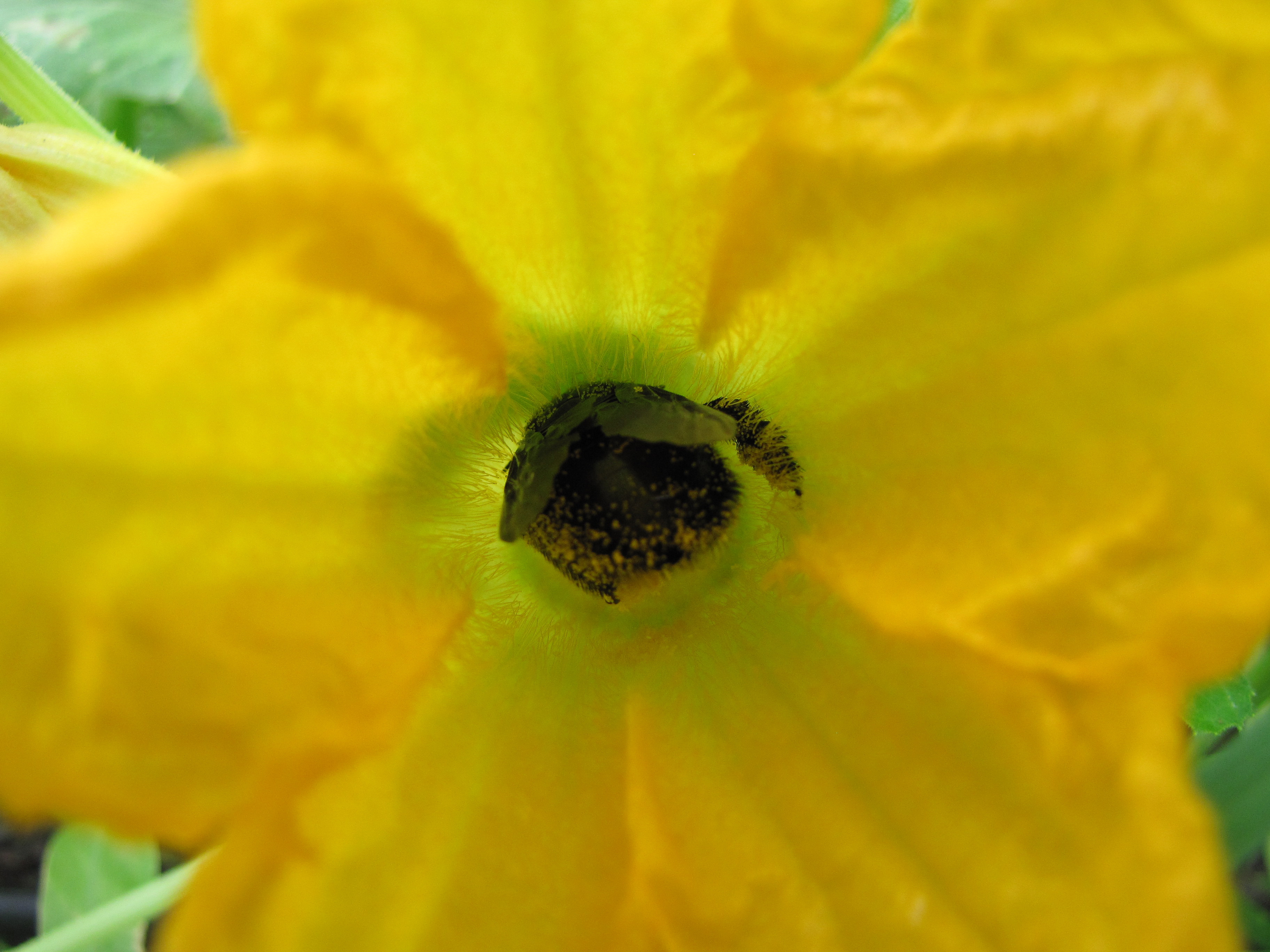
The Backside of a Bee Drinking Deeply from a Squash Flower

The Backside of a Bee Drinking Deeply from a Squash Flower

Flowers use rich colors to attract bees, soft and sticky textures, symmetrical shapes, heady perfumes, and even ultra-violet light to draw bees into the flower.  Plants literally train bees to seek out their flowers when the nectar is at its peak of sweetness–the perfect moment for pollination.

The flowers themselves must all bloom simultaneously to make this work; to capture and hold the attention of the bees.   The flowers are guided through their flowering by precise changes in soil temperature, rainfall, and sunshine; and the changes in sun and rain are compelled by even greater forces.

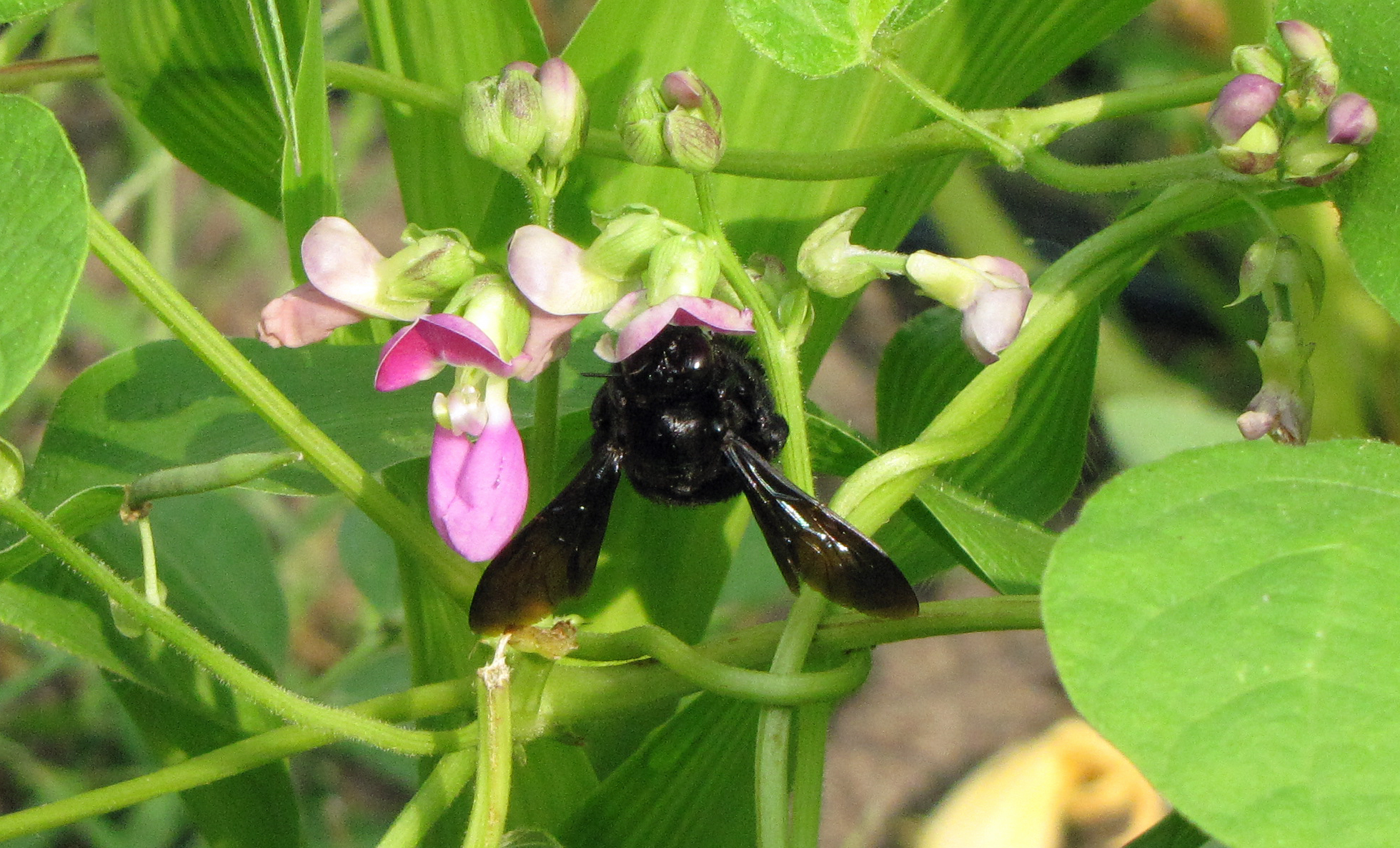
 Bee Upside-Down on Bean Flower

Bee Upside-Down on Bean Flower

Beneath the seemingly erratic flight of bees, there is a grand design at work.  Every part of the garden is linked to all the other parts in a complex network of relationships–and the gardener is an important part of this network.

To attract bees to your garden, generously plant flowers among your vegetables.  Nasturtiums, marigolds, Queen Anne’s lace, cosmos, and sunflowers are all great companions to vegetable crops.  Bees especially love the flavor of herbs:  plant basil, dill, and cilantro in between your vegetable plants and let them go to flower.  And the best plant of all to attract bees is blue borage, with its little blue flowers shaped like stars.

Flowers bring successive waves of color and fragrance to your vegetable garden.  The flowers are beautiful, and for bees, the flowers are electric:  they turn off and on like lights to guide bees through the pollination of your garden.

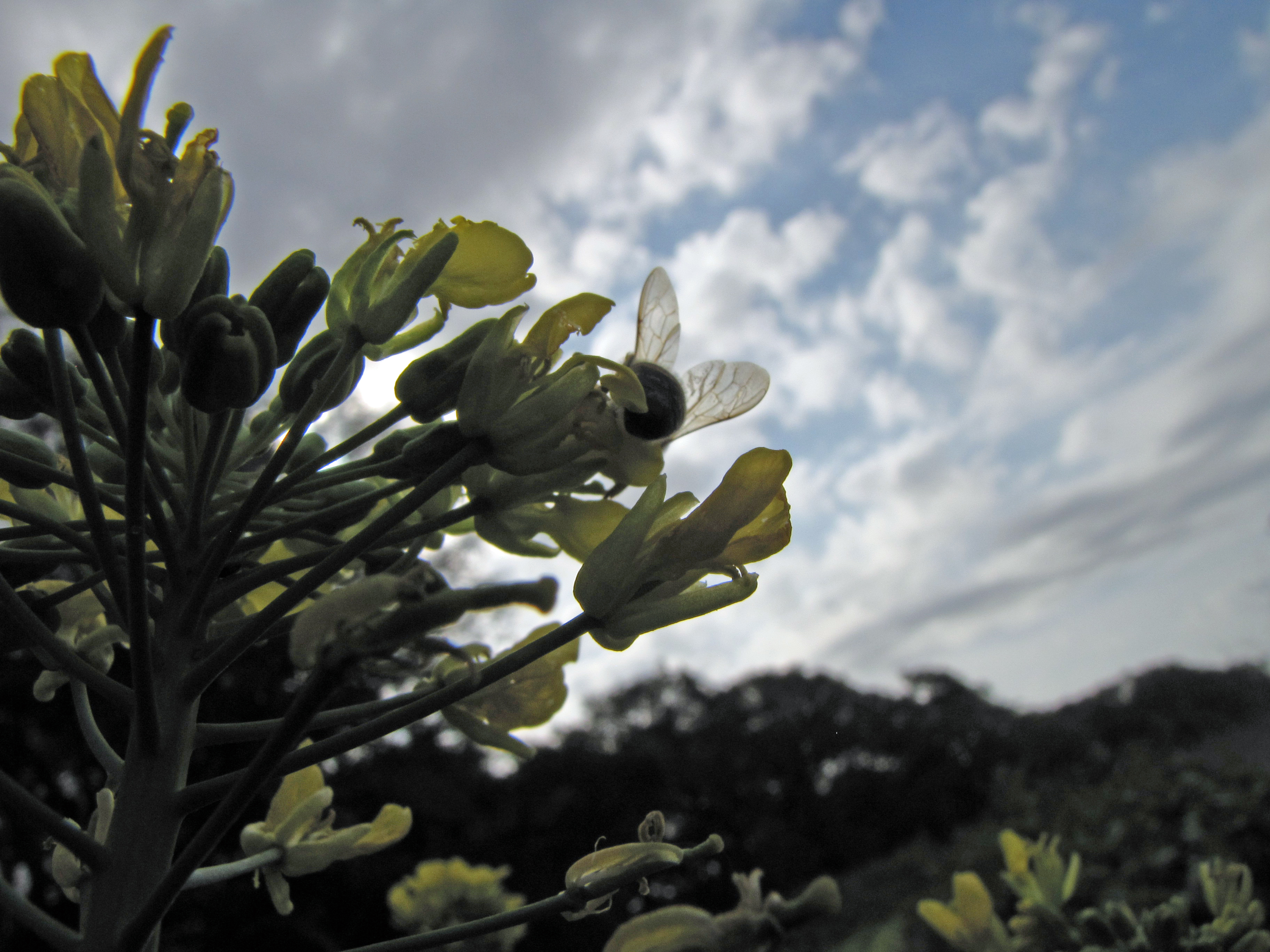
Bee with a Cloudy Sky

Bee with a Cloudy Sky

The Sweetness of Wood Ash

Adding Wood Ash while Transplanting a Tomato

Adding Wood Ash while Transplanting a Tomato

Did you ever taste a tomato that was so sweet, and so good, that it seemed to just explode with flavor?  What is the secret to growing incredibly delicious produce?

If you want to maximize the flavor of your garden, try adding wood ash from native trees to your soil.

Wood ash is rich in potassium and other minerals.  Plants need potassium to transfer glucose, or sugar, from the plant into the actual fruit.  When more potassium is available in the soil, more sweetness and flavor is released into the fruit or vegetable.

Wood ash also strengthens and invigorates your garden.  If there is not enough potassium in the soil, plants become yellow, weak, and anemic.  Wood ash also helps plants more efficiently absorb water, which reduces irrigation to the garden.

Potassium is essential for human health, as well.  A potassium deficiency in our diet causes fatigue and irritability, and can even lead to hypertension and chronic heart disease.  The best source for humans to get potassium is from fresh fruits and vegetables, and the best source for plants to get potassium is from wood ash.

The wood ash trade was a big business in America from the Colonial Period through the 1800’s.  Americans converted much of their seemingly endless forests into wood ash and shipped it to Great Britain to sweeten English crops.  Wood ash was typically boiled down in huge pots–which is the origin of term potash, even though modern commercial potash is not derived from wood ash.  When boiled with animal fats, wood ash was used to make soap, and Americans increasingly diverted their wood ash to the manufacture of soap.  By the Civil War, wood ash became unsustainable in large-scale agriculture, and corporate farms turned to industrial sources for potassium.  The secret sweetness of wood ash was forgotten.

Pushing Live Oak Trees and Limbs into Pile on Garden to Burn

Pushing Live Oak Trees and Limbs into Pile on Garden to Burn

To make wood ash, only use wood from native trees:  pecan, mesquite, or live oak.  Never ever use ash from trash or treated lumber, which is toxic when burned.  The best place to make wood ash is in your fireplace, and save the ash in large zip-lock bags.

In the old days, farmers would simply build a fire right in the middle of their garden, and then rake the cooled ashes into the soil.  If you use this method, please be careful and check for local burn ban restrictions.  Also, build several small fires in each section of the garden, rather than one huge bonfire, which can scorch the delicate soil and destroy microbial life.

On our farm, we push our live oak limbs and fallen trees into huge piles and let them sit.  When there is a temporary lift in the burn ban, we notify the fire department, and then safely convert the limbs into wood ash.  We pack the ash into old feed bags and store it in a dry place in the barn.  Between plantings, we gently rake the ash into our soil.

You only need about one and a half pounds of wood ash per 100 square feet of garden space, applied every six months or so.  A little wood ash goes a long way.

If you want to grow incredibly sweet and flavorful produce, try adding wood ash from native trees to your garden soil–you will taste the difference.

A Handful of Live Oak Wood Ash at Bottom of Hole, another Handful Around Base of Plant

A Handful of Live Oak Wood Ash at Bottom of Hole, another Handful Around Base of Plant

Chartroom Dinner Sold Out

Friends, our dinner tonight at the Chartroom has sold out.

If you have reservations, Kayla and I are excited to join you for dinner at 6:30pm.  Chef Chris Veatch is preparing something very special.

If you were not able to make a reservation, please come back soon and visit the Chartroom for an elegant meal with a beautiful view.

South African Gem Squash on the Menu Tonight

South African Gem Squash on the Menu Tonight

The Language of Dogs

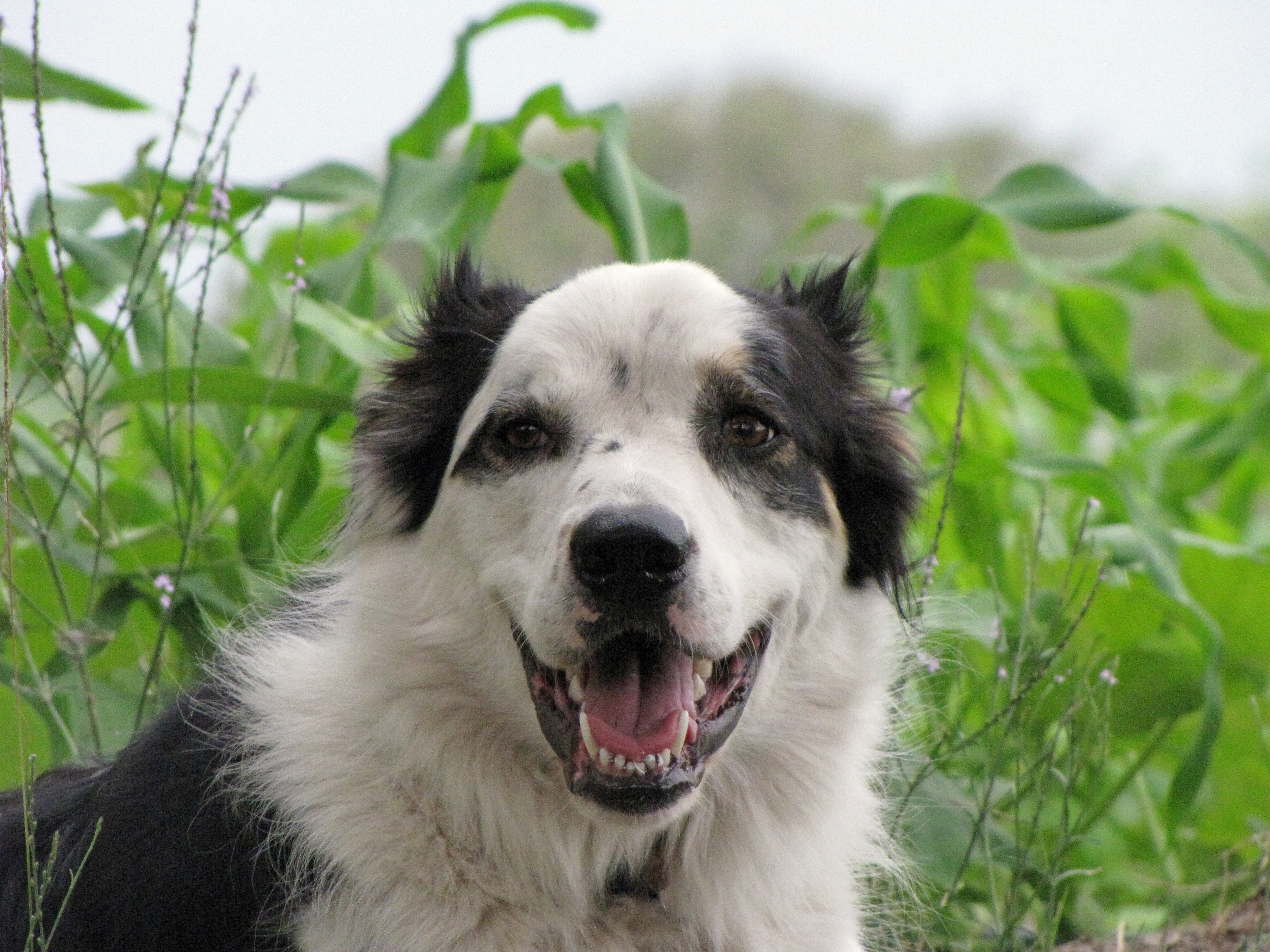
Bando Watching for Snakes while Kayla picks Kale

Bando Watching for Snakes while Kayla picks Kale

Gardeners often ask how we keep gophers, squirrels, and other predators out of the crops on our wilderness farm.  We use an old-fashioned and highly effective technique:  a good dog.

Our farm dog has at least 11 distinct barks, and I can instantly tell the difference in each one.

He has one bark for deer and a slightly different bark for raccoons, and he will not tolerate any of them in our gardens.  He has one bark for hawks when they attack our chickens, one for coyotes, and yet another bark for foxes.  And we rarely, if ever, lose a bird.

He has a bark for wild hogs when they tear through the yard, and a completely different bark for our domestic hogs when they dig out of their pens and run loose on the farm.

He has one bark, more of a deep-chested growl, for poisonous snakes, and he has a slightly different bark for alligators.  I learned the subtle difference in his alligator bark as a shocking surprise, directly at my feet on a dark night, and my dog lunged at the alligator and fought him all the way down to the water.

Bando Eliminates ALL Gopher Problems

Bando Eliminates ALL Gopher Problems

Our farm dog is named Bando.  He is a black-and-white Border collie mix with a big bushy tail.  Bando has an important job on our farm, and he is brilliant in his work.

There are many hard-working dogs like Bando on the farms and ranches of South Texas:  dogs working their cattle and goats, protecting gardens and homesteads, and they are the unsung heroes of small-scale agriculture.

Dogs served in exactly the same way 200 years ago on the American frontier, helping their pioneer families cultivate a civilization.

And probably the greatest masters of dogs were Native American Indians.  Before the arrival of Europeans, Indians did not have livestock:  no horses or cows, goats, sheep, or pigs.

But Indians had dogs.  Indian children and puppies grew up together into warriors and pack leaders, sleeping, hunting, foraging, and fighting together in the closest proximity; protecting one another in a partnership of survival.

It is difficult to imagine how well Native Americans understood their dogs; how a certain kind of bark, or a slow rise of the hackles, could speak volumes.  Recognizing this language, at a primitive level of survival, could mean the difference between death, and life.

Bando at Full Speed by Chicken Pen

Bando at Full Speed by Chicken Pen

Every dog has a powerful desire to serve his master in some way.  For some dogs, it is to hunt; for others, to protect; and for some, it is simply to lay in the laps of their masters.  The greatest gift we can give our dogs is to let them to fully express this instinctual desire—to let them work to their hearts’ content, whatever their job.

If predators are stealing from your garden, the solution may simply be a good dog.  And your dog might just love the work.

Bando Protecting the Corn Crop

Bando Protecting the Corn Crop

Come to Dinner at Chartroom, next Thursday

Chartroom Rockport – 39 Mazatlan Drive Rockport, TX 78382

Friends, Kayla and I invite you to dinner at the Chartroom restaurant in Rockport next Thursday, May 30.  Dinner will begin at 6:30pm.

I am very excited to partner with Chef Chris Veatch of Chartroom to bring local food to your table, cooked to its perfection.  The menu will feature locally-harvested seafood, plus a creative use of our pork and freshly-picked produce:  squash, tomatoes, beans, kale, collards, chard, beet greens, and herbs.  Details to follow.

Please join Kayla and I next Thursday at 6:30pm for a wonderful dinner with a gorgeous view.  For reservations, call 361-790-2450.  Chartroom is located at 39 Mazatlan Drive in Rockport, in the Key Allegro marina.

Himalayan House-Heating Compost

Himalayan Farm Family

Himalayan Farm Family

While trekking through the Himalayan Mountains of northern India, I met a farmer in an isolated village who showed me an ancient and fascinating use for compost. 

The growing season in the Himalayan Mountains is very short.  Farmers have five months, from May through September, to grow all their produce for the year. 

Winters in the Himalayan Mountains are long and brutally cold.  The severe weather can trap families in their tiny thin-walled houses for months at a time.  These folks don’t have electricity, and they can’t afford fuel to continuously burn fires, so they use compost to heat their homes.  Here’s how it works:

The houses are very small, and there are two levels:  an upper level, where the family lives, and a lower level, where the cow lives. 

By the onset of winter, the farmer has tightly packed the entire upper floor with hay.  He pens the cow into the lower level and throws hay down to the cow each day during the winter.  The cow eats most of the hay, but some falls to the ground to be trampled on.

The hay on the ground mixes with the cow’s manure and forms compost.  The compost generates an internal temperature of around one hundred degrees Fahrenheit and radiates a continuous moist heat throughout the entire house.  The compost keeps the family nice and warm, even on the coldest winter nights.

The compost pile grows as the cow adds manure and the farmer adds hay; however, the temperature of the compost remains constant.  By the end of winter, the cow is standing on top of a tremendous compost pile, and her head is bumping against the ceiling. 

Cow Walking to Himalayan Two-Level House

Cow Walking to Himalayan Two-Level House

I stayed with the family at the end of summer, when the upper level was packed with hay.  The farmer’s wife prepared a meal of curd curry on a Franklin stove.  The narrow space of floor around the stove, with its extra heat, served as kitchen, living room, and bedroom for the entire family, seven people in all. 

The farmer offered me a glass of mint tea, and his wife graciously dropped a huge dollop of fresh butter into the tea as a sweetener.  In addition to heat and compost, the cow also provided fresh milk for butter, curds, cheese, and yogurt.  Not only that, the fuel for the Franklin stove was actually dried cow patties that the farmer carefully preserved for their cooking fires.     

Sitting with the family in the living quarters, I was able to look down through the cracks in the floor and see the brown back of the cow, and listen as the cow added urine to the compost pile in a long loud stream.  However, because the farmer balanced the compost with plenty of carbon-dense material, neither the cow nor the compost gave an off-odor.  In fact, the house smelled pleasant and fresh and clean. 

With the arrival of spring, the farmer turns the cow loose to forage on the mountainside.  Then he shovels all of that wonderful compost onto his gardens, and plants his seeds, and grows another year’s worth of produce in the rich black soil.