The Scent of a Radish

A Harvest of Radishes

A Harvest of Radishes

Freshly-picked radishes can be spicy, sweet, flavorful, and delicious.  Unfortunately, the all-you-can-eat salad bars of the 1980’s ruined radishes for most of us.   But even if you don’t like to eat them, radishes can play an important role in your garden.

Radishes were first cultivated in China, and they were carried along the ancient Silk Road to Rome, and then northward throughout Europe.  The Conquistadors and the Pilgrims brought radishes to the New World in the holds of their ships, and pioneer settlers carried them west.  I first learned the value of radishes in the lush gardens of Japan, where daikon is a dietary staple.

Radishes for Pest Control

On our farm, we grow radishes primarily for pest control.  The scent of a radish repels and confuses pest insects.  To protect your delicate winter greens from bugs, companion plant a variety of radishes liberally throughout the garden.

You can also plant a thick line of radishes across the width of your garden beds every few feet down the rows.  Plant your greens and carrots and broccoli right up to the line of radishes on either side.  The radishes will form walls, or barriers, to trap insects into confined areas, where they are easier to eliminate.

Whether you need to remove your bad bugs by hand (the pinch method), or spray them with Bt (a natural treatment for caterpillars), pests are easier to find and do less damage when they are confined in your radish “bug traps”.  Also, beneficial predators seem to have an easier time hunting pests when they are trapped in confined areas.

Purple Radish Flowers

Purple Radish Flowers

Bees and Beneficial Predators

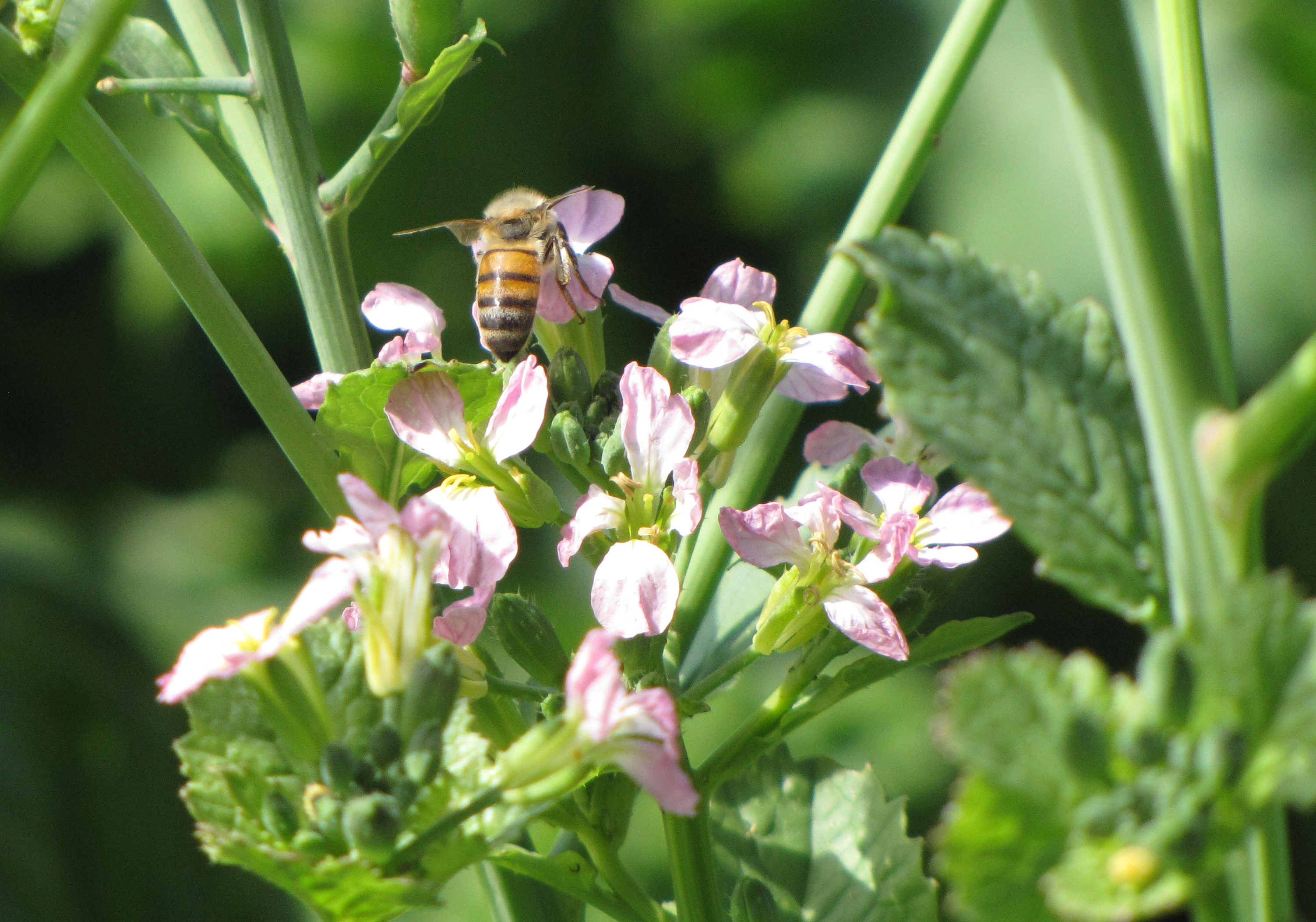
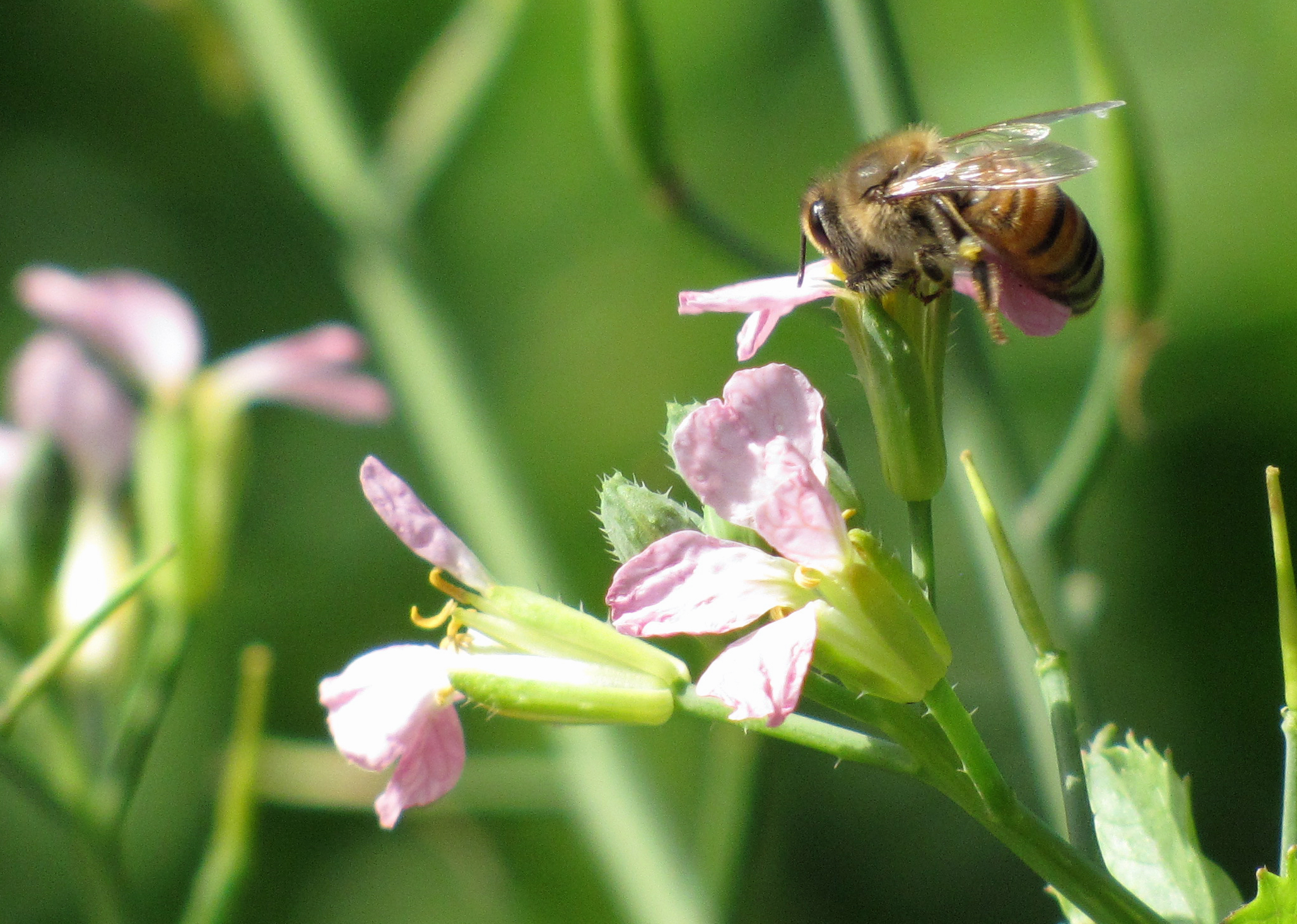
Mature radish plants offer a brilliant display of pink, purple, and white flowers, and radishes are the one plant we can count on to flower in the coldest weather, even when they are covered with frost.  The flowers serve as a beacon to draw bees and beneficial predators into the garden, especially when they are the only flowers blooming in the bleak winter landscape.
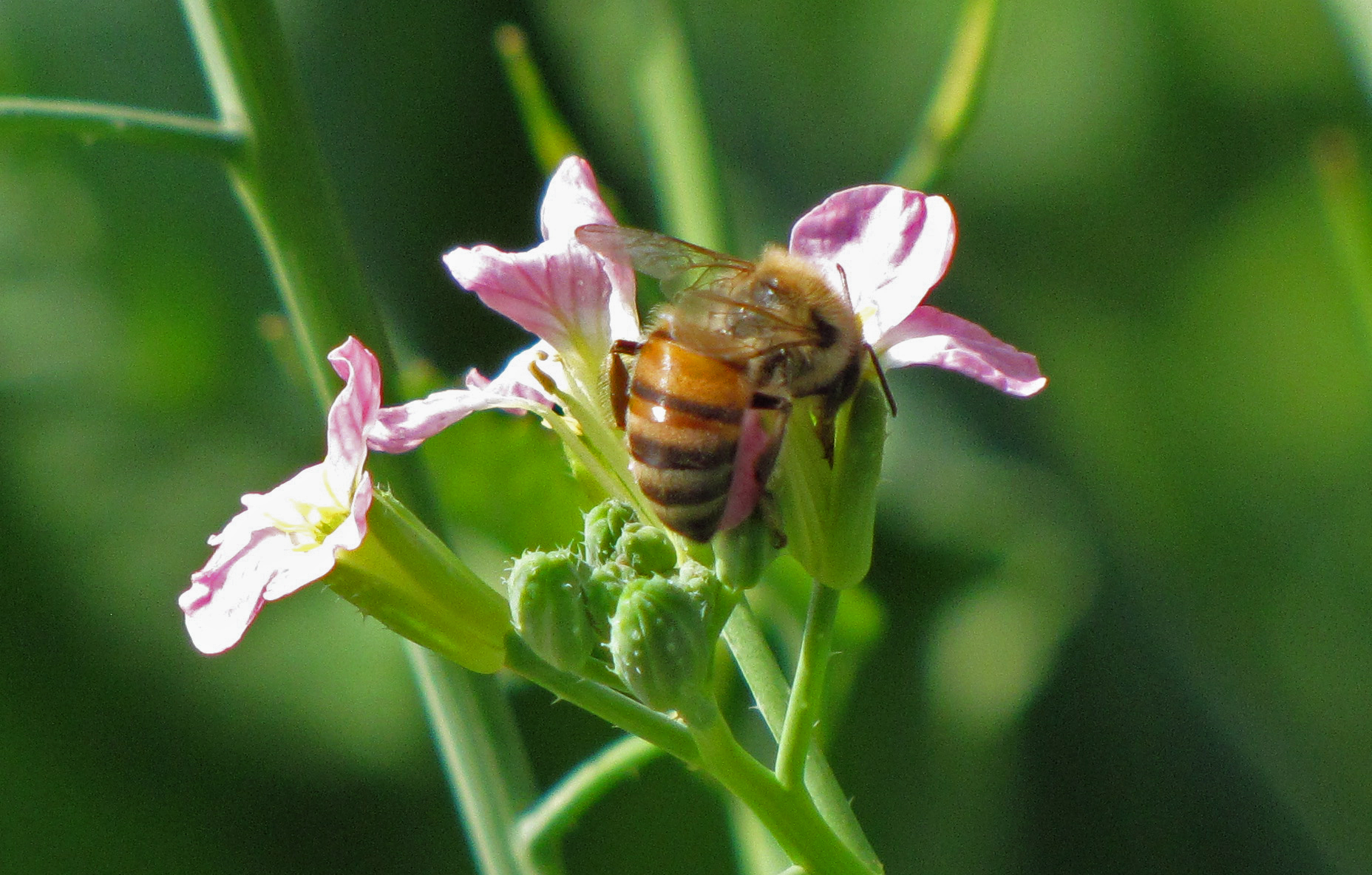
Radish, Bee Drinking

Radish with Bee Above

Radish with bee buzzing

Radish with Bee Pollinating

Radishes Help Chickens Make Delicious and Nutritious Eggs

If you leave them in the ground long enough, radish roots can grow up to ten or fifteen pounds.  I harvest these huge bushy radishes and feed them to our laying hens, and the hens devour them, root, stalk, and all.  Radishes are an inexpensive and highly nutritious food source for our chickens during the winter, when green material is scarce—and radishes help chickens produce exquisitely delicious eggs.

Laying Hens Enjoying Radishes

Laying Hens Enjoying Radishes

Varieties of Radishes

The standard varieties for radishes are cherry bell, scarlet globe, white icicle, sparkler white tip, and long scarlet, but there are dozens of varieties to choose from.  Plant as many different types as you can find, because different varieties are better at resisting different types of pests, and you might even find some tasty radishes that you like to eat.

Daikon is a Japanese radish with a wonderful flavor, and there are many exotic radish varieties from the Orient with incredible flavor.  The quicker you harvest radishes once they mature, the sweeter the flavor; and the longer you leave them in the ground, the hotter and more pungent they become.  I realize that with radishes “sweet” is a relative term–not sweet compared to chocolate bars and strawberry sodas, but sweet enough when they are the first taste of out your winter garden.

Kimmi of Coastal Bend Health Foods with a Bunch of Radishes

Kimmi of Coastal Bend Health Foods with a Bunch of Radishes

Eating and Cooking Radishes

Every part of a radish plant is edible, and the flowers are a unique delicacy.  Shake the radish plant over a bowl to catch the flowers, and sprinkle them on salads and meat dishes.  Radish roots are best pickled or roasted with other root vegetables, like carrots and parsnips.

Successively Planting Summer Vegetables with Radishes

If you plant radishes now, in mid-December, they will be ready just after the New Year, and the scent of your radishes will protect the garden for the rest of the winter.

On the first day of March, when your radishes are dripping with fragrant flowers, pull them out of the ground, and simply drop your tomato, eggplant, and pepper transplants into the open holes.  Cover the new transplants with compost, and keep your garden going through the spring and summer.
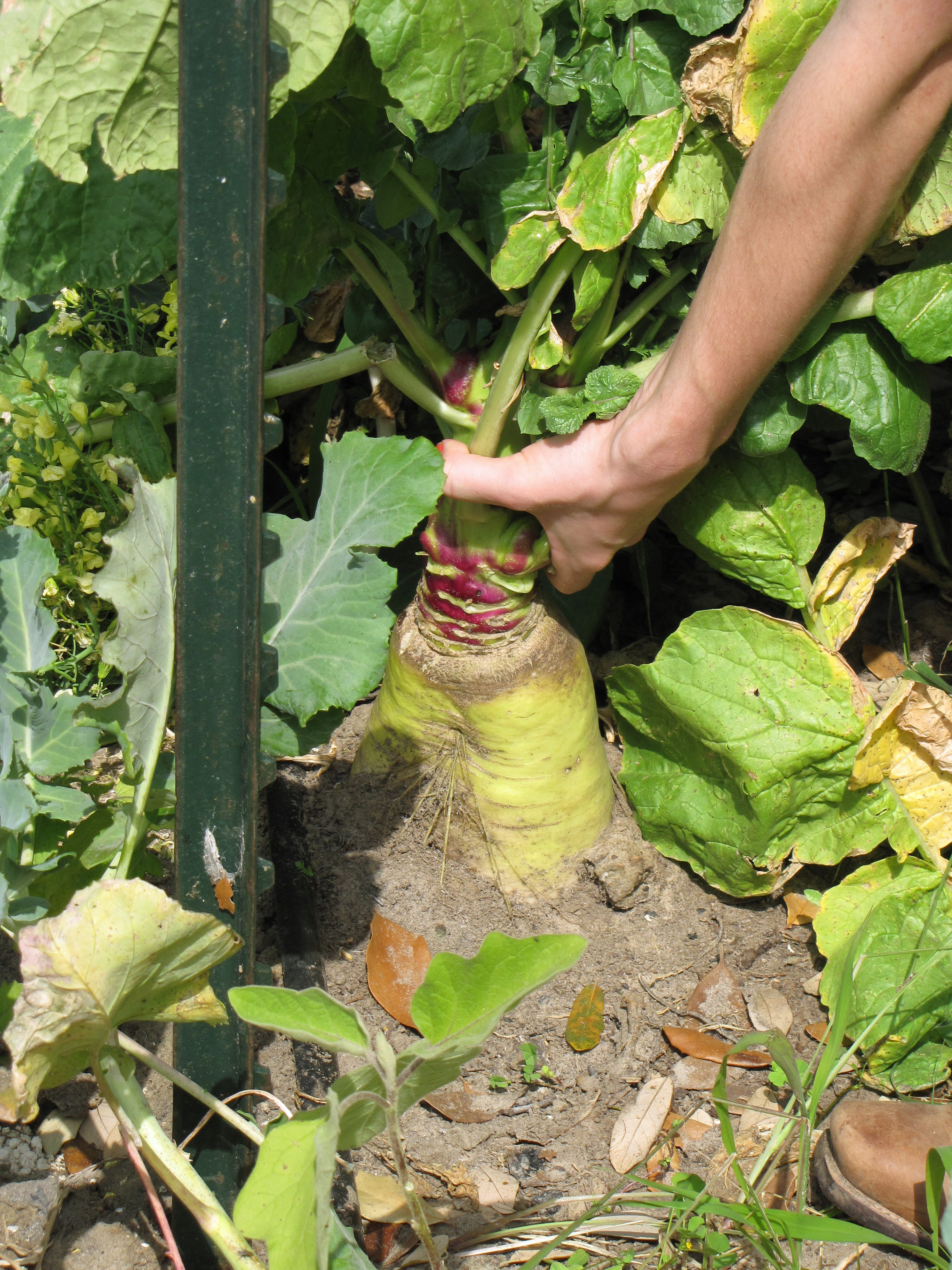
Pull this 15 lb radish, feed it to the chickens, and plant a tomato in its place.  Notice the T-post for the tomato trellis is already in the ground.  We put the posts in when we plant the winter garden, so it is easier to transition it to a summer garden later on.

Pull this 15 lb radish, feed it to the chickens, and plant a tomato in its place. Notice the T-post for the tomato trellis is already in the ground. We put the posts in when we plant the winter garden, so it is easier to transition it to a summer garden later on.

The Story of Crisco

Lard Ad from 1916.

Lard Ad from 1916.

In the early 1900’s, there was a tin pail of lard in nearly every kitchen in America.  Lard was the universal shortening.

The demise of lard began in 1906, when Upton Sinclair published his book, The Jungle, which exposed the gruesome reality of the Chicago meat-packing plants.  Sinclair claimed that workers would sometimes fall into the boiling vats of lard and became part of the product.

The Jungle was a work of fiction, and President Teddy Roosevelt called Sinclair a “crackpot” who was “hysterical, unbalanced, and untruthful.”  Nevertheless, Sinclair set the stage for a bold new competitor to lard.

Around this time, William Proctor and James Gamble realized that the rise of electric lighting was about to put their candle-making company out of business.  But Proctor and Gamble made a key scientific breakthrough:  they discovered that hydrogenating the process to make their cottonseed oil candles would turn the candles into a white, lard-like substance.  They called this invention Crisco vegetable shortening (the vegetable was cotton).

Proctor and Gamble launched Crisco in one of the brilliant marketing campaigns of the 20th Century.  P&G positioned Crisco as a new type of food, clean and pure, a product of science, healthier and safer than lard.

Crisco, The Story of CriscoIn 1912, P&G released a beautifully-written and gorgeously-illustrated cookbook with hundreds of recipes using Crisco.  This cookbook, The Story of Crisco, was printed in numerous languages to target niche ethnic markets.  Jewish homemakers in particular were early adopters of Crisco as a kosher product.

P&G gave away the cookbook with their product and mailed it all over America, which was a very big deal at the time.  The Story of Crisco was treasured by early 20th Century homemakers and stands to this day as a monument to food marketing genius.

P&G paid celebrity chefs to lead cooking classes featuring Crisco to establish the credibility of the brand.  The company claimed in advertising that Crisco would instill good moral character in children.  They paid scientists to produce research that supported their health claims.  Crisco hammered away at the health theme for decades.

Crisco was a pioneer of print media during WWI, radio in the 1920’s, and television in the 1930’s.  The dual marketing strategy was to promote the purity of Crisco while subtly undermining lard.

The lard industry, controlled by a consortium of good old boys, mistakenly believed they held an eternal monopoly on shortening.  Lard industry leaders failed to recognize the threat from Crisco in time, or to successfully defend and promote their product.  Lard was demonized to the extent that even today the word lard itself invites disgust.  Eventually, Crisco completely replaced lard in the kitchens of America.

Crisco’s product health claims were seriously challenged in the 1990’s when scientists revealed the truth about trans fats.  Despite numerous product reformulations, Proctor and Gamble divested itself from the Crisco brand in 2001.

The Crisco campaign of the 20th Century was enormously effective in shaping attitudes and beliefs among consumers.  Lard, a wholesome product that had been loved by Americans for centuries, was utterly destroyed in the marketing arena by an imitation food that was created in a lab and manufactured from cotton.

Modern food companies are even more sophisticated and more effective in their food marketing messages.  We are bombarded constantly with these highly compelling messages.

As a consumer, it can be difficult to know what to believe, to know the real story behind the advertising.  But the closer we eat to home, to local farms, and to our own backyard gardens, the easier it is to know the truth about our food.

(I found the following vintage advertisements for lard on the site ecofriendlyfreckles.com.   It is no wonder lard lost the advertising war!)

Lard, a happy family (newsblaze)

All You Need is a (LARGE) Spoonful!

All You Need is a (LARGE) Spoonful!


The Circadian Rhythm of Plants

Sunset in the Garden

Sunset in the Garden

Scientists have announced a fascinating discovery about the secret life of plants.  It turns out that plants are governed by circadian rhythms, just like people.  And the circadian rhythm operates in plants even after they are harvested—even while the plants are sitting in warehouses, on grocery store shelves, or in your refrigerator.

And not only that, scientists have learned that circadian rhythms have a significant impact on the nutritional value of the plants we eat.

In plants, just as in people, circadian rhythms are endogenous, which means they originate in the cellular memory of the individual.  Our personal circadian rhythms are programmed into our DNA.  Circadian rhythms are also heavily influenced by environmental factors, such as day and night, and the rhythm can be altered with changes in the light/dark cycle.

The peak of a plant’s circadian rhythm is in the afternoon, when plants most require energy to fight heat stress and protect themselves from insect attacks.  The low ebb of the circadian rhythm for plants is the middle of the night, the same as in people.

In the recent study, scientists observed how the circadian rhythm affected the concentration of glucosinolates in plants.  Glucosinolates are compounds produced by plants to strip toxic substances from their cells.  In humans, glucosinolates are cancer-fighting agents that remove carcinogens from our bodies.  To do the most good for our health, we want to eat produce with the highest concentration of glucosinolates in every bite.

Scientists manipulated the light/dark cycle for certain plants to produce 12 hours of light and 12 hours darkness, to simulate the day and night conditions of plants in the field.  They found that plants achieved their highest concentration of glucosinolates during the afternoon, when the plants were at the peak of their circadian rhythm.

In fact, the concentration of these cancer-fighting compounds was twice as high during the afternoon compared to the middle of the night, when the plants were at the low ebb of their circadian rhythm.

It is remarkable to consider how much the nutritional density of plants can fluctuate in twelve hours simply due to changes in light.  And the circadian rhythm is only one of many factors that influence the health and taste of produce.

Scientists continue to learn new information about the nutritional density of our food.  Plants are living matter–living energy–even after the plants are harvested.  This living energy fuels our work, our growth, our wellness, our busy lives.  The quality of the plants, and the quality of the potential nutrition of the food, depends largely upon how it is grown.

To get the most nutritional density from your produce, harvest it fresh from your own garden or buy it from a source that offers locally grown and freshly picked vegetables.  Thanks to scientists, we now know that we can enjoy our produce not only at the peak of ripeness, but also at the top of the circadian rhythm, as well.

Kimmi and Justin in the Studio Tuesday Morning

Kimmi Norvell Moake and I will be in the studio tomorrow, Tuesday morning, from 8:00am to 9:00am with radio host Leanne Winkler.  Tune in to 90.3 FM in Corpus Christi and 90.7 FM in Victoria to listen.

We will be in the studio to discuss Coastal Bend Health Foods’ underwriting of “Your Wholesome Heritage Garden” and also to support KEDT during their Fall membership drive.

We ask you to tune in to the program and call in with your support!  Call 361-855-2000 to join us with a pledge for quality public radio programming–you can pledge $20 or $5 or even a dollar.  Every single pledge is appreciated and goes to support KEDT and their excellent radio programming.

You can call in from wherever you are to say hello, even outside our listening area, and we sincerely thank you!  We look forward to hearing from you Tuesday morning!

Radio Underwriters Announced

Friends, I am pleased to announce a new underwriting partnership for our radio program.

Coastal Bend Health Foods, Latitude 28 02, and Chartroom of Rockport have signed an agreement with KEDT/KVRT to underwrite “Your Wholesome Heritage Garden”.

As underwriters of the program, these companies will be featured in sponsorship messages associated with our weekly radio program,  “Your Wholesome Heritage Garden”, and other quality programming on KEDT-FM 90.3 in Corpus Christi and KVRT-FM 90.7 in Victoria.

KEDT and KVRT enjoy the largest radio audience in South Texas.  The listening area covers 20 counties and runs from north of Victoria all the way to the south of Kingsville.  Each time our program is broadcast, the listenership is in the tens of thousands, and the audience is growing.  KEDT/KVRT programming has a considerable reach and impact.

Many of these listeners will be introduced for the first time to Coastal Bend Health Foods, Latitude 28 02, and Chartroom.  I am so excited about the many connections that will be made; the good people who will learn about these wonderful businesses and come to Rockport to try them out.  Our neighbors in South Texas will be delighted with what they find in our little town.

These business owners in Rockport sponsored “Your Wholesome Heritage Garden” because they believe in the program and because they want to support public radio and our community.  I am so thrilled and honored to partner with Kimmi, Ramona and Craig, and Chris Veatch.

Friends, I ask you to support these businesses by paying them a visit.

Kimmi Norvell Moake, Coastal Bend Health Foods

Kimmi Norvell Moake, Coastal Bend Health Foods

Thank you to Kimmi Norvell Moake of Coastal Bend Health Foods for your radio sponsorship.  Kayla and I cannot say enough good things about Kimmi, she is like family to us and she is the most wonderful person you will ever met.

She offers the freshest produce in town, grass-fed beef, pastured chicken and pork, farm fresh eggs, a full range of supplements, specialty groceries, and natural beauty products.   Please stop in and visit.

Ramona and Craig Day of Latitude 28 02

Ramona and Craig Day of Latitude 28 02

Thank you to Ramona and Craig Day of Latitude 28 02 for your radio sponsorship.  I became friends with Ramona and Craig more than thirteen years ago when they opened the restaurant, and they have created a true work of art in our town.

Latitude 28 02 is fine dining in an art gallery.  The most beautiful paintings in South Texas line the walls of this restaurant, but the food is the star of the show, and I believe the best artist in the place is the chef.  Call to make a reservation, and enjoy!

Chef Chris Veatch of Chartroom

Chef Chris Veatch of Chartroom

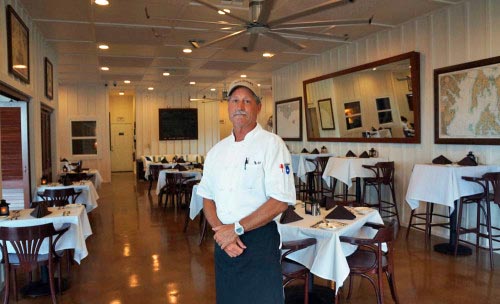
Thank you to Chef Chris Veatch of Chartroom for your radio sponsorship.  Chef Chris spent thirty years up in Vermont perfecting his craft, where he shopped daily among the local farms for his produce.  When Chef Chris and I partnered to host a dinner featuring ingredients fresh from our farm, he truly blew us away.  We are all still talking about that amazing dinner, and Chef Chris serves up these kinds of meals every day.

The view from Chartroom is the marina in Key Allegro.  You can enjoy your dinner and drinks while watching folks pull up in their sailboats and yachts and walk down the pier and come sit at the next table for a delicious supper.  It is quite an experience.  Please stop by the Chartroom for dinner, you will be so glad you did.

There will be more to share soon about these wonderful sponsors.  Thank you for your support of our local businesses in Rockport!

Exploring South Texas Food with Cabeza de Vaca

When I started my farm business, years ago, I studied everything I could find about the agricultural techniques of Native American Indians.

Our South Texas Indian ancestors were expert farmers.  They successfully cultivated our harsh and unforgiving land, and made their living on it.  I knew they could teach us a great deal about how to plant a modern garden.

Our part of the country–the sandy strip of land along the Gulf Coast from Victoria to the south of Corpus Christi–is one of the toughest places in America to farm.  I wanted to know how the local Indians, with nothing more than simple stone tools, thrived on this land.  The best information I found about South Texas Indians came from a Spanish Conquistador by the name of Cabeza de Vaca.

Cabeza de Vaca was a great explorer in an age of adventure.  He set sail from Spain with a dream to colonize Florida, but after series of mishaps, he was shipwrecked on Galveston Island.  The year was 1528, and Cabeza de Vaca was the first European to set foot in Texas.

The local Indians rescued him from the windswept waves and kept him as a slave.  But Cabeza de Vaca used his ingenuity to escape to the mainland.  He vowed to somehow find his way to Mexico City–the closest Spanish settlement at that time—a 700 mile hike through a beautiful and treacherous landscape.

Probable Route of Cabeza de Vaca (1528 through 1536)

Probable Route of Cabeza de Vaca (1528 through 1536)

Cabeza de Vaca traveled south along the Gulf Coast, trekking through the future cities of Victoria, Corpus Christi, and down through the Rio Grande Valley.  He crossed the Rio Grande, turned west, and then this remarkable explorer walked all the way to the future site of El Paso, then on to the Pacific Ocean, and finally down to Mexico City.

He began this eight-year odyssey as a slave, but along the way he became a powerful shaman, and soon the Indians of Texas and Mexico worshiped him as a god, The Child of the Sun.  When he reached salvation in the Spanish settlements, he had an entourage of nearly three thousand Indians following along behind him.

The land he discovered was densely populated–before disease and warfare decimated the Indian tribes.  Cabeza de Vaca describes how at one point he walked for hundreds of miles through beautifully cultivated farmland.  In other areas, the natives lived on the brink of starvation with only their genius for procuring food from the thorny earth to sustain them.

Cabeza de Vaca wrote about his adventures in extraordinary detail.  He told precisely how the Indians of South Texas farmed and foraged, hunted and fished, and how they cooked their hard-earned harvest.

I used many of these methods in the design of my farm.  In future posts, I will follow Cabeza de Vaca on his journey and learn what he discovered about indigenous South Texas farming.  I will unravel these ancient techniques, and hopefully you can use them to help make your own garden more robust, more productive, more interesting, and more delicious.

Winter Gardening Class Next Wednesday

Radish Flowers

Radish Flowers

You are invited to a winter gardening class with Justin Butts next Wednesday, August 14, from 10:00am to 12:30pm.  The class will be held at the Aransas County Extension office at 892 Airport Road in Rockport, TX 78382.

This class is sponsored by Texas A&M AgriLife Extension and the Master Gardeners of Aransas County.

Winter is a wonderful time to garden in South Texas with beautiful weather, bountiful vegetables, and minimal pest problems.  Join us to discover the chemical-free methods we use on our farm to grow healthy, delicious, and prolific produce.

Call the Aransas County Agricultural Extension Office at 361-790-0103 for more information, or go to http://aransas.agrilife.org  for more information.  There is a $10 registration fee for this class.

The class will be held indoors in the state of the art classroom facility at the Aransas County Extension Office.  The class will focus on:  1) preparing the soil for a Fall/Winter garden, 2) companion planting from seed to maximize yield and variety, and 3) controlling pests naturally.

Gardeners of all ages and skill levels are welcome.  Even if you have never planted a seed, you will go home with the knowledge to start your own successful winter garden.

What:  “Winter Gardening Class” with Justin Butts

When:  Wednesday, August 14, from 10:00am to 12:30pm.

Where:  Aransas County Extension office 892 Airport Road, Rockport, TX (361) 790-0103

Who: All gardeners of all ages!

Working in a Winter Garden

Working in a Winter Garden

Wasps Killing Caterpillars

Wasp Killing Caterpillar and Turning it into Liquefied Balls to Stuff in Nest (photo courtesy of Chelsie Vorachek)

Wasp Killing Caterpillar and Turning it into Liquefied Balls to Stuff in Nest (photo courtesy of Chelsie Vorachek)

I have a clear memory from childhood, at five or six years old, of my father running across the lawn in his boots and his cowboy hat, yelling at the top of his lungs.  He was carrying a can of wasp nest spray in his hand, and he was being was chased by a big cloud of wasps.

The only thing I learned from this scene was to fear wasps, and that was an unfortunate lesson.  It took me a long time to realize that wasps are highly beneficial in the garden.

Wasps eat an enormous amount of caterpillars and other garden pests.  The wasps from a single small nest can quickly eliminate an entire pound of insects from a backyard garden–and that is a lot of garden pests you will never have to worry about.

Wasps patrol among the plants hunting.  When a wasp sees a caterpillar, the wasp attacks and stings the caterpillar to paralyze it.  Then the wasp picks up the caterpillar, flies it back to the nest, and stuffs the caterpillar into the holes of the comb.  The queen lays her eggs inside the caterpillars, and the baby wasps eat their way out.

Wasps Stuffing Chambers with Caterpillars

Wasps Stuffing Chambers with Caterpillars

Mud daubers only eat spiders, and some mud daubers species only eat brown recluse or black widow spiders.  The mud dauber paralyzes the spider, picks it up and flies or drags it back to the nest, and then stuffs the still-living spider into one of the chambers.  The mud dauber babies move through each chamber of the nest and first eat the legs of the spiders, to keep them alive longer, then go back and eat the spider heads, then the bodies.

It is best to let mud daubers do their work, because there is no chemical insecticide as effective as mud daubers at controlling the spider population around your home.

Yellow Jackets Working on Nest

Yellow Jackets Working on Nest

In every generation of wasps, only a few of the females, the ladies-in-waiting, survive the year.  They hibernate in cracks and crevices during the winter and emerge in the spring to build new nests.  If you destroy a nest and kill these ladies-in-waiting, your pest population will get far out of control long before the wasps can repopulate and help you in the garden.  Wasps never re-use their nests, so wait till autumn when the wasps are gone, if you want to clear out old nests.

To attract wasps to your garden, all you need to do is leave their nests alone, unless the nest is in a doorway or high-traffic area.  Nobody wants a wasp sting, but the truth is that wasps rarely attack, unless someone is bothering their nest, as my father can certainly tell you.  And Dad can’t run as fast as he could in the old days, so now he leaves the wasps alone—and that suits me just fine.

On our farm, we encourage a healthy wasp population, and that is one of the reasons we never have to use toxic pesticides in our gardens.  In fact, these days, I am more concerned about seeing a can of wasp nest spray, than I am about the wasps.

Wasp Nest in Garden Shed (I worked around and very close to this large nest in the shed all summer and never had a single problem with the wasps.  And these wasps ate a LOT of caterpillars!)

Wasp Nest in Garden Shed (I worked around and very close to this large nest in the shed all summer and never had a single problem with the wasps. And these wasps ate a LOT of caterpillars!)

Wasp Curiously Watching the Picture-Taker

Wasp Curiously Watching the Picture-Taker

Wasp Killing Caterpillar (Photo Courtesy Ginger Easton Smith)

Wasp Killing Caterpillar (Photo Courtesy Ginger Easton Smith)

Root Knot Nematodes

Root knot nematodes are tiny parasitic worms that feed on the roots of vegetable plants.  Nematodes thrive in hot, sandy soil, and they fiercely attack tomatoes, peppers, squash, melons, and most other garden vegetables.  These microscopic parasites are one of the greatest enemies of South Texas gardeners.

Nematodes are especially frustrating because they reveal themselves only through the damage they do to your plants.

To diagnose a nematode attack, look for the above-ground symptoms:  yellowing, wilted plants; stunted plant growth; and poor yields of small misshapen fruit.   The damage may begin in one part of the garden, but nematodes quickly spread through the soil, on garden tools, or even on the soles of your boots.  Nematodes increase with the heat and are most destructive in the hottest weather.

Nematode Damage on Left, Normal on Right (photo courtesy Univ of Maryland)

Nematode Damage on Left, Normal on Right (photo courtesy Univ of Maryland)

If you dig up a wilted diseased-looking plant, you may find knots, or galls, on the roots; this is the clearest indication of nematodes.

The extent of damage to vegetables depends on the density of nematodes in the soil.  One nematode can lay between 500 and 1,000 eggs, and they rapidly reproduce new generations.  Nematodes simply overwhelm plants with their numbers.

The best solution to nematodes is to prevent them in the first place.  Nematodes have trouble getting a foothold in healthy, humus-rich, well-mulched soil.  Healthy soil stays cool in hot weather and conducts water efficiently to the roots of plants.  Healthy soil is a hostile environment for nematodes.

Good crop rotation is essential in preventing nematodes–no matter how big or small your garden.  Nematode eggs can survive in the soil for a full year, and they love to eat the same types of roots as the previous year.  Divide your garden into three or four quadrants, and rotate your plantings to confuse nematodes and increase the bio-diversity of the soil.

To eradicate a severe infestation of nematodes, plant a thick cover crop of French marigolds on your garden and till the flowers into the soil.  Marigolds are excellent for soil health, and they produce a toxin that is deadly to nematodes.

Porkers Deeply Till the Soil

Porkers Deeply Till the Soil

On our farm, we fight nematodes by pasturing pigs on our gardens after each harvest.  The porkers consume the entire network of roots from the garden and transform those roots into powerful fertilizer.  This process destroys nematodes while building extraordinarily healthy soil.

Nematodes are responsible for a lot of damage to South Texas gardens, but you can easily control them through good gardening practices.  A healthy garden is the best cure for nematodes and for most other garden pests as well.

The Invention of Farming

An Ancient Wild Barley Sample (photo courtesy TISARP and NPR)

An Ancient Wild Barley Sample (photo courtesy TISARP and NPR)

Archeologists recently discovered the ruins of a 12,000-year-old farmstead in the rugged mountains of Western Iran.  This site—situated in the long-vanished Fertile Crescent, the cradle of civilization–is one of the earliest documented farmsteads in the world.

These ancient farmers grew wheat, barley, lentils, and peas.  They domesticated these plants by collecting wild seeds and then planting them in a concentrated space.  The seeds were perfectly preserved at the archeological dig along with a few stone tools, a sickle, and a mortar and pestle for grinding grains.

For historical context about this time period, 12,000 years ago, the dinosaurs were gone, but the progenitors of Native American Indians were still crossing the frozen land bridge from Asia into North America.  As they worked their way south, these first Americans still hunted wooly mammoths with their fire-hardened spears.

Meanwhile, in the remote mountains of the Fertile Crescent, the first farmers developed practical and sophisticated agricultural techniques.  They selected the plants that were easiest to cultivate in their soil and climate.  They used wood ash as a soil amendment, homemade compost, and native leaves as mulch.  These techniques, the most ancient of heritage methods, are just as effective today for backyard gardeners.

An Ancient Farmstead in the Zagros Mtns of Iran (photo courtesy TISRP/Univ of Tugengen/NPR)

An Ancient Farmstead in the Zagros Mtns of Iran (photo courtesy TISRP/Univ of Tugengen/NPR)

But how did those first farmers figure it out?  How did they put it all together?  It may have been as simple as a husband and wife at this farmstead discussing it over a dinner of freshly-picked wild grains.  They figured it would be easier to relocate the wild plants to their own garden, rather than roaming for miles every day hoping to forage something to eat.  This simple innovation is how farming was invented.

Around the same time, in the nearby mountains of Iraq, the very first sheep were being domesticated.  Hunters caught living wild lambs, and instead of butchering and eating them right away, they bred them into tame flocks.  By domesticating wild seeds and wild animals, and raising them in permanent locations, these first-ever farmers changed the world.

In this ancient farmstead, archaeologists also found clay pots and bowls decorated with artistic renderings.  The first farmer grew food in abundance, which freed up someone else’s time to make pottery, to store this new surplus.  And that freed up time for the first artists to decorate these clay pots, and to paint dramatic images of animals on the walls of their caves.

But that first farmer, standing in the first field ever planted, was simply doing his best, her best, to cultivate their own little patch of land, to grow enough food to feed their family—doing their best to survive in this great wide-open world.  And farmers are still doing the same thing today.