Companion Planting with Tomatoes

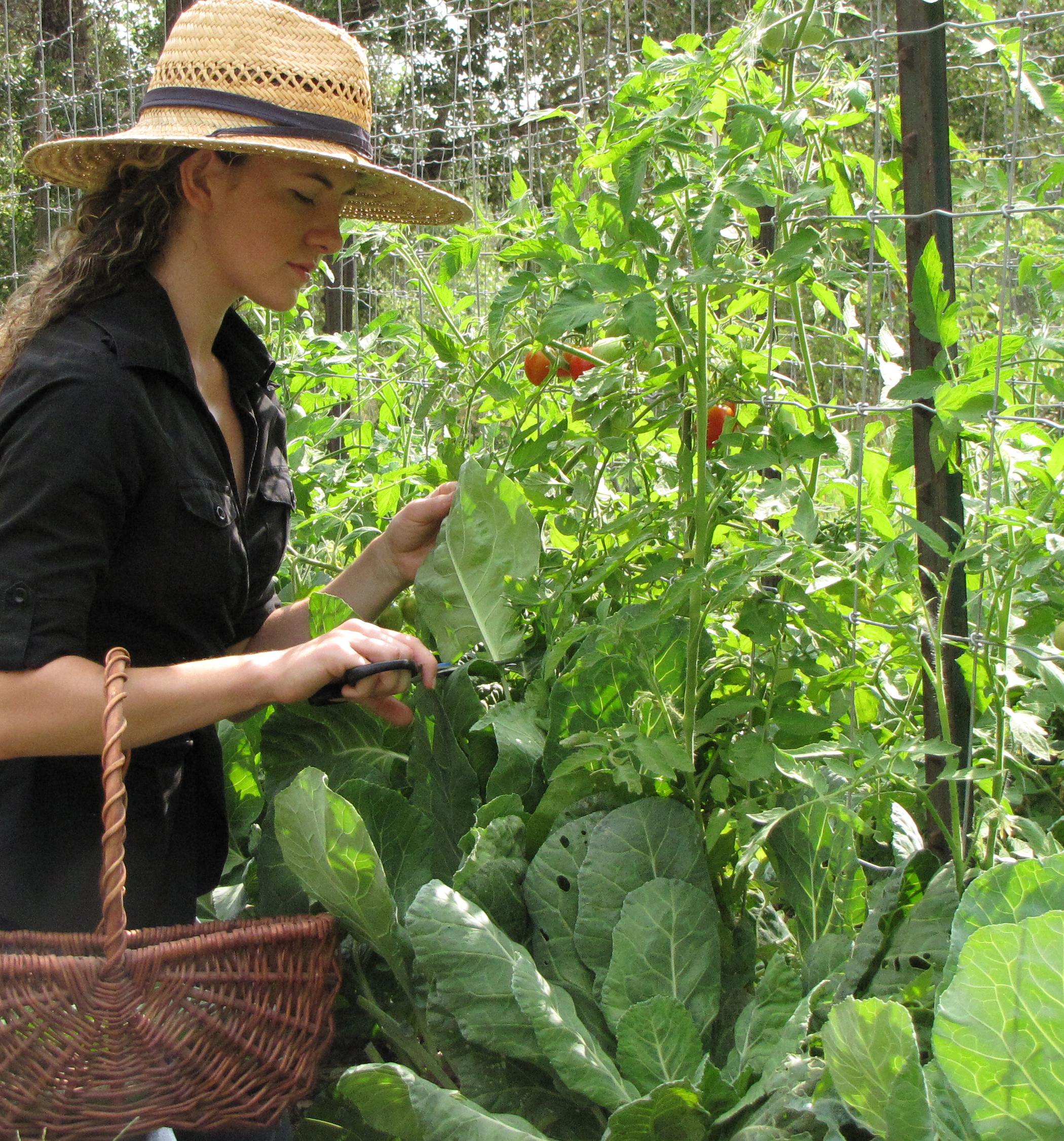
Collards Growing at the Base of Tomatoes.  Hog Panel Trellis.

Collards Growing at the Base of Tomatoes. Hog Panel Trellis.

The sun is slowly heating up in the sky over South Texas, and the soil is ready for spring planting.  Now is the time to get those tomatoes into the ground.

To achieve the greatest production from your tomato plants, you might consider companion planting.

Companion planting is the close spacing of two, three, or more plants together, where each plant helps and strengthens the others.  Every plant in nature—every vegetable, herb, fruit, and flower—grows better when planted in the right combination with other plants.

Nature always strives to create diversity in plant life, and companion planting harnesses this productive power of nature and channels it into the garden.

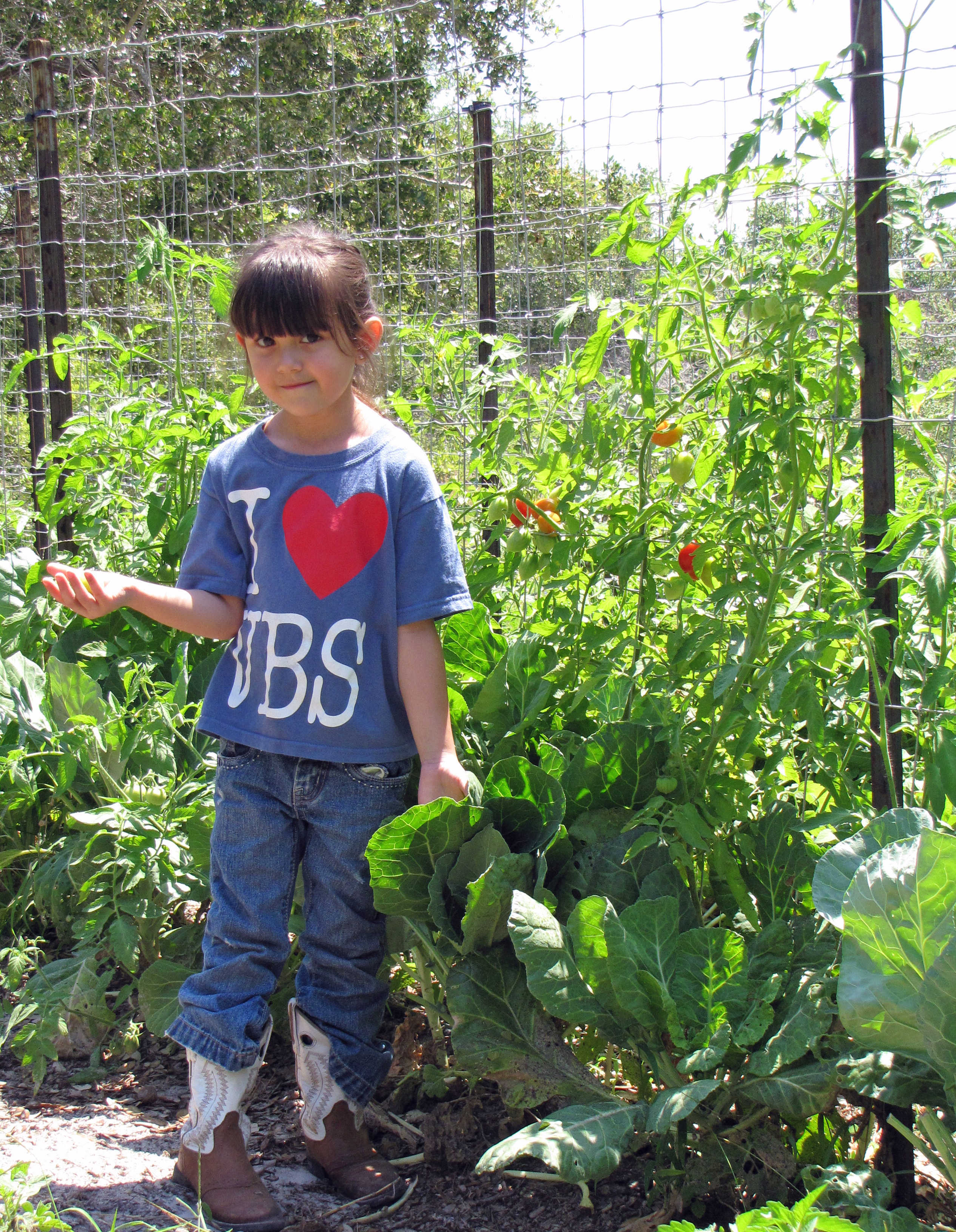
The best companion for tomatoes is collard greens.  Plant four collards closely spaced around the base of each tomato, and continue this pattern down the row.  The leaves of the collards will grow together and form a dense canopy over the soil.  This canopy preserves soil moisture, prevents weeds, and provides a sanctuary for beneficial predators–frogs, toads, lizards, and lady bugs.

Collards emit a subtle odor that repels many of the insect pests that attack tomatoes.  The tomatoes will vine thickly up their trellis and offer much-needed shade to the collards, while the collards keep the soil at the feet of the tomatoes nice and cool.  And best of all, you can harvest your collards along with your tomatoes all through the hot summer season.

Marigolds make excellent companions for tomatoes.  Densely plant a couple dozen marigolds around the base of each tomato plant.  The perfume of marigolds pushes nematodes away from the roots of your tomatoes.  And the vibrant yellow and orange flowers set a colorful stage for the lush green tomato vines.

Dill, basil, and cilantro are also excellent companions for tomatoes.   Plant these herbs generously throughout the tomato bed and let them go to flower.  These herbs are beautiful, edible, and their aroma repels many insect pests from the garden.

The best combination of all is to plant collards, marigolds, and herbs all together throughout your tomato bed.  The plants will not crowd each other.  Instead, they will work together to maximize the beauty, fragrance, pest resistance, and food production in every square inch of your garden.

Collards Companion Planted with Tomatoes

Collards Companion Planted with Tomatoes

The Imprinting of Birds

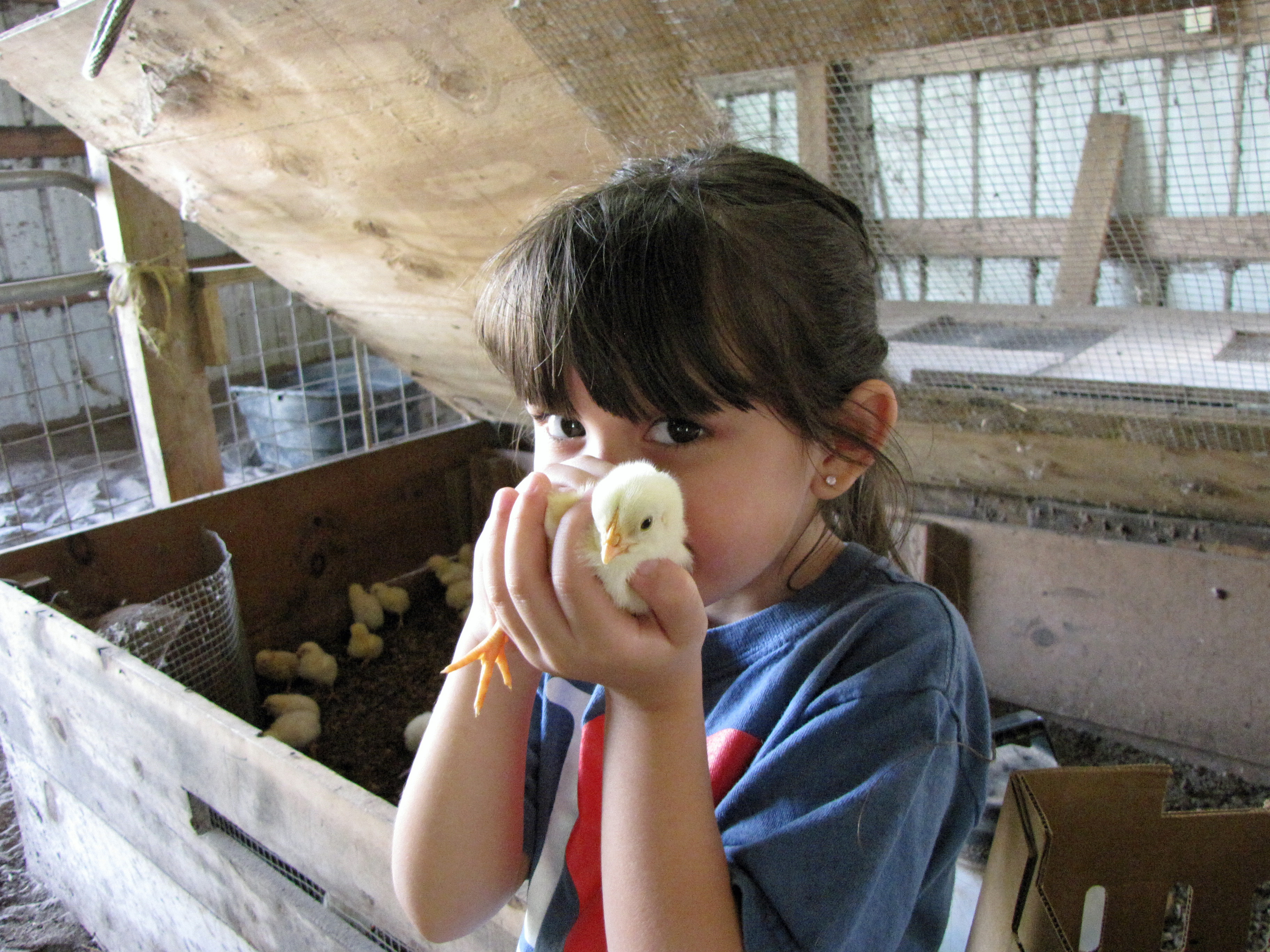
Imprinting Baby Chicks

Imprinting Baby Chicks

When a baby chick hatches from the egg, the chick imprints on the first moving object that it sees.  The chick believes the imprinted object to be its mother, even if that object is a human being.  Imprinting stamps the mind of a bird with a lifelong image of itself, and that initial stamp is irreversible.

Farmers have long known about imprinting.  In ancient China, farmers imprinted their newly hatched ducklings with a special stick.  Whoever carried that stick could lead great flocks of ducks through the fields each day and back home again at night to their roosts.

In 1973, a scientist named Konrad Lorenz won the Nobel Prize for his ground-breaking research around imprinting.  Dr. Lorenz discovered that human-imprinted birds would not perform courtship rituals in the wild, because the birds were confused about their identity.

This research explained why human-imprinted whooping cranes would not mate when released into the wild.  Now, when whooping crane chicks are hatched in captivity, their human caretakers wear giant crane costumes to feed the chicks, to make sure the chicks imprint to cranes, and never to people.  This development has helped the wild whooping crane population begin to reestablish itself.

Picking up Chicks from the Post Office

Picking up Chicks from the Post Office

On our farm, we receive most of our chickens as day-old chicks mailed to us from a hatchery.  When I open those boxes full of newly-born, chirping little chicks, they are imprinted with my image, and for the rest of their lives they run to me when I open the gate, and crowd around my heels and follow me.

Sometimes, however, a rogue hen will fly the coop and lay her eggs in secret somewhere in the forest.  When these chicks hatch, they imprint to the mother hen.  These bird-imprinted hens are skittish and they run away when I open the gate.  Human-imprinted laying hens are much easier for a farmer to manage.

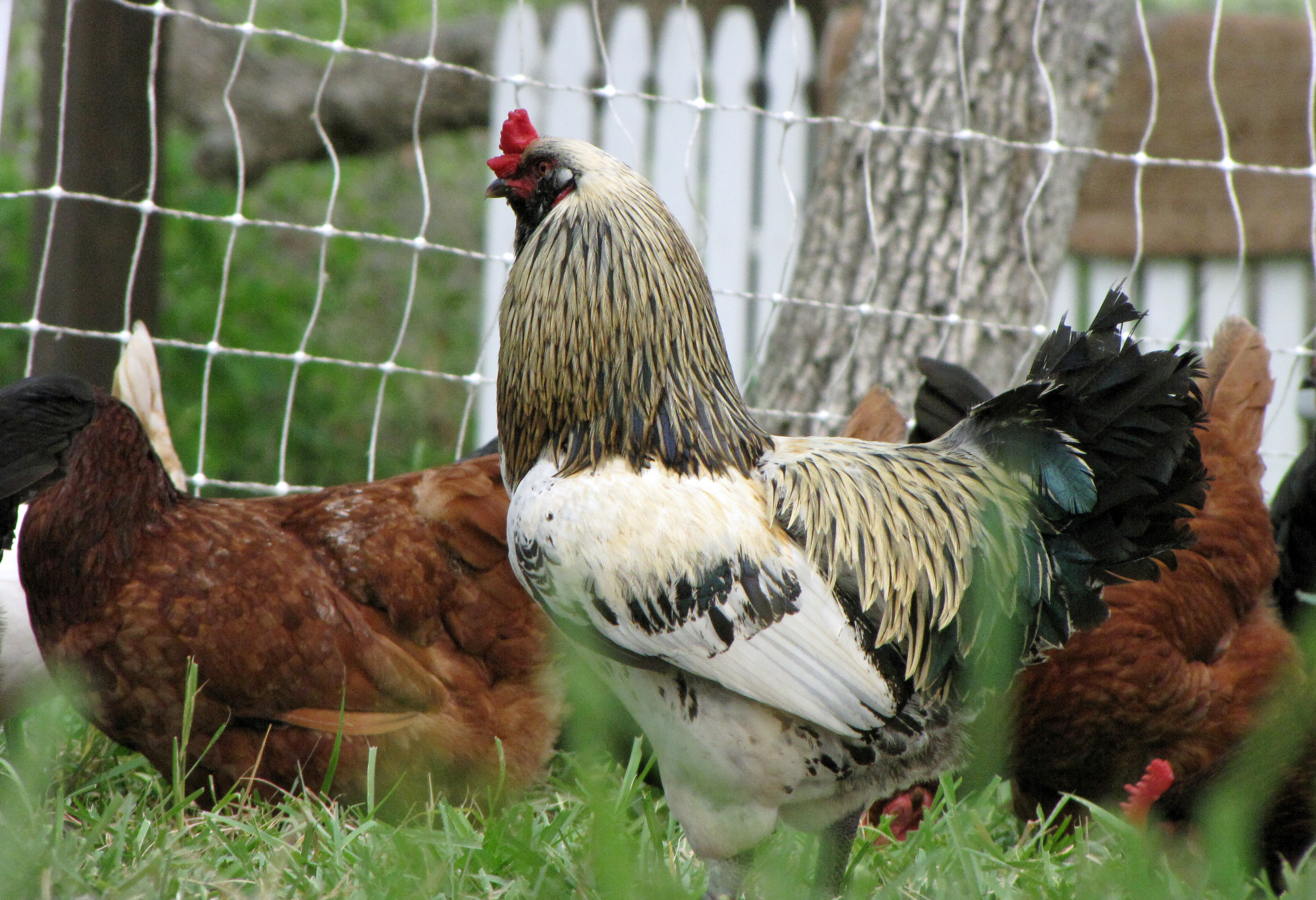
A Good Rooster

A Good Rooster

However, the best roosters are bird-imprinted—the chicks born to the rogue hens.  These roosters understand the natural order—they maintain discipline in the hen house but they are not aggressive toward people.  Usually, belligerent roosters that attack people are human-imprinted birds, and they think of people as competitors for their hens.

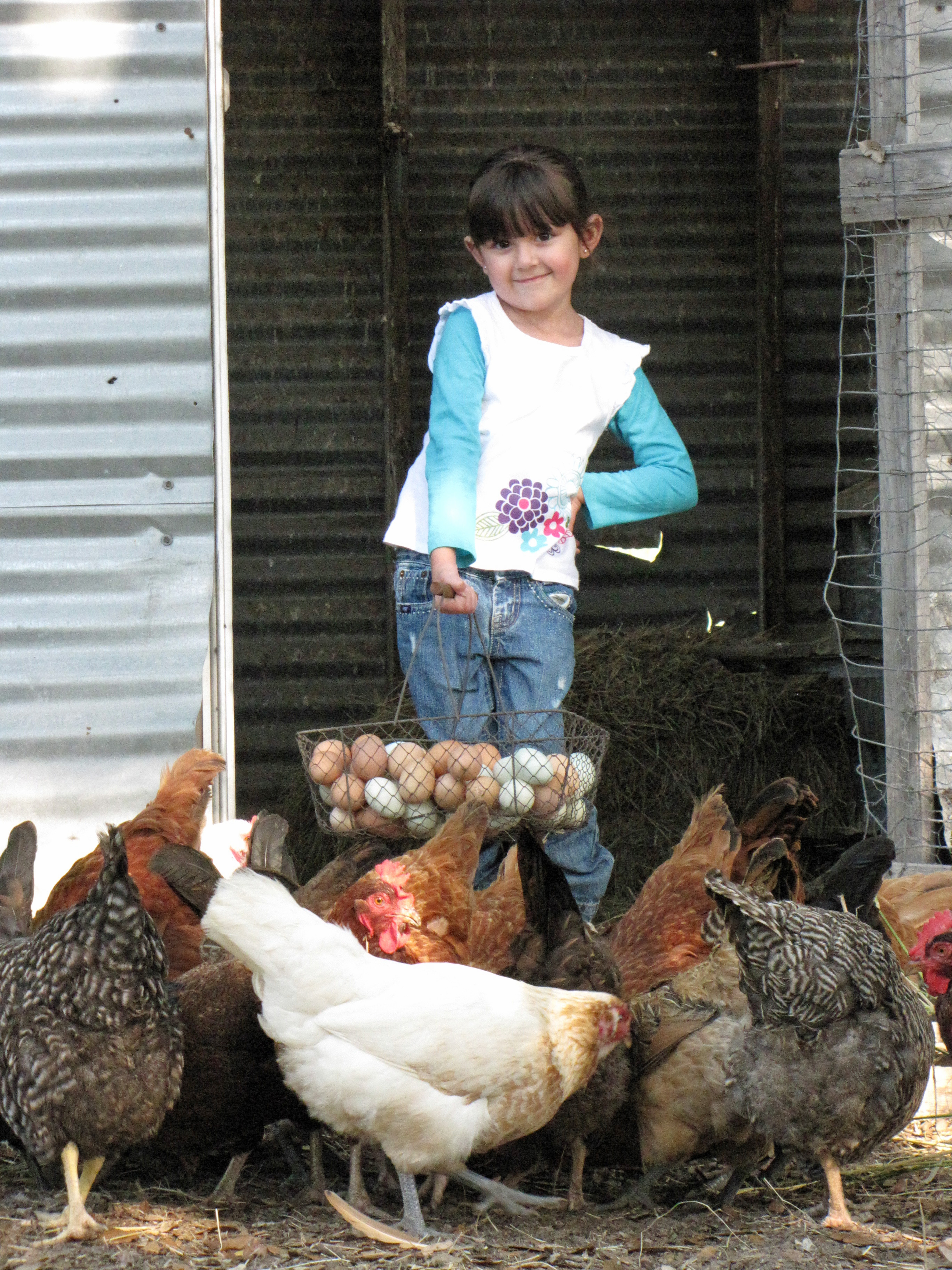
These days, my favorite imprinting technique is to have my six-year-old daughter open the box when baby chicks arrive in the mail.  She imprints her sweet face onto the chicks, and when those chicks grow up into laying hens, they are very friendly to her when she goes out to collect their eggs.

Gathering Eggs

The Ideals of the Ancient Olympians

The Entrance to the Stadium at Ancient Olympia

The Entrance to the Stadium at Ancient Olympia

For the Olympic athletes in Sochi, nutrition is a science, and diet is a central focus of the competitors.  Diet was just as important to the first Olympians, some 2,700 years ago.  And for Ancient Greeks, food was about much more than nutrition.

What Ancient Greeks Ate

The ancient Greeks did not have many foods that today’s Greeks take for granted:  tomatoes, peppers, eggplant, corn, potatoes, chocolate, and many types of fruit and spices.  These foods would remain exclusive to the New World or to Asia for a long time into the future.

Ancient Olympians ate simple foods.  For meat, they had mutton, beef, goat, and pork.  Greeks who lived by the sea ate fish, although for many centuries fish was considered a food of the poor.  Access to fresh fruit was limited; accordingly, Greeks ate a lot of dried fruit.  Dried figs were a staple of the Greek diet.  They ate a flatbread made of wheat, barley, or rye.  Honey was their sweetener.  They used herbs intensively in their cooking, which was done in earthen ovens or roasting fires.  And Greeks loved their wine and olive oil.  Athletes actually bathed themselves in olive oil before competitions.

Justin and Kayla in Greece

Justin and Kayla in Greece

Milo of Croton, the Wrestler

One of the original Olympic champions, Milo of Croton, was the greatest wrestler of Ancient Greece.  He won a gold medal at six consecutive Olympics games, and a silver in his seventh competition.  To finally defeat him, a new school of wrestling, called standing or long-armed wrestling, was invented.  The long-armed wrestling kept Milo on his feet and at arm’s length until the old man could be worn down and finally pinned after nearly thirty years.

At one of the Olympic Games, Milo picked up a four-year-old bull and carried it around the stadium on his shoulders in front of 50,000 screaming spectators.  Then he butchered it, cooked it, and ate the entire thing in front of his fans.  I would hate to have to wrestle that guy.

Milo ate up to 20 pounds of meat per day, but Milo was the exception.  Greek athletes typically sought balance in their diet, and they were very careful about what they ate.

The Original Olympic Field

The Original Olympic Field

Food Fads in Ancient Greece

The food, along with the training regimen of the competitors, continually evolved over time.  Occasionally, a great champion would emerge who ate a peculiar diet, and this diet would launch a food trend across Greece that lasted sometimes for decades.

Once, when a great champion emerged who ate a meat-only diet for a year prior to the games, a meat-only diet craze spread across Greece.  This fad lasted for a long time.  If a champion announced that he never ate bread prior to a competition, Greeks across the country would shun bread until a new athlete emerged who swore by bread.  In some years, eating honey became a fad, and honey was sought in great quantities to give energy to athletes.  In other years, honey was avoided because it was believed that sugar slowed down an athlete.

These food fads differed from modern fad diets, because there was not a lot of marketing and commercialization involved, but rather a quest for perfection and purity in the diet.  While the great philosophers were thought leaders in Greece, the Olympic athletes led the food trends.

Justin at a Temple to Zeus

Justin at a Temple to Zeus

The Sacred Truce

Thirty days before each Olympic competition, a Sacred Truce was declared, and runners were sent all over Greece with a special disk which declared free and safe passage to the games, no matter what kind of wars the city-states might be waging.  The Sacred Truce was held so dear that it was never violated for 800 years, which says a lot about how important the Olympic Games were in Greece.

As the games increased in popularity, every element of the competition was honed to the highest level of perfection, including the food.  Winning a gold medal was the highest honor in the Greek world, and the champions of Ancient Greece were bigger than the rock stars of today.  A great champion might spend the rest of his life being entertained by the wealthiest Greeks, and having honors heaped upon him.  He would likely be hired to train young Olympians in the art of competition, and he would make a lot of money at this.  Part of this training was diet.

Kayla at Olympic Ruins with the Entrance to the Stadium to the Right

Kayla at Olympic Ruins with the Entrance to the Stadium to the Right

Perfection of the Parts  

The diet of ancient athletes was simple, but the purity of their food was of paramount importance.  The ideal of Greek philosophy was perfection in forms:  perfect laws; perfect statues; perfect athletes.  To achieve this ideal for the whole, the parts must first be perfected.  Sculptors, for this reason, went to great lengths to obtain the finest marble for their statues of the gods.

Athletes likewise demanded the purest foods in their diet, to build their muscles, to chisel their bodies.  The farmers considered themselves artisans, no less than sculptors.  Their tools were sun, rain, seed, and soil.  Farmers, like the athletes they partnered with, strived for greatness.

Ancient Olympia was very Isolated and Surrounded by Barren Rocky Hills

Ancient Olympia was very Isolated and Surrounded by Barren Rocky Hills

Food that Traveled

Farmers competed to grow the best and purest foods for their athletes.  Animal husbandry, types of fertilizer, management of the soil, plant selection, and other techniques were employed to continually improve the quality of the food offered to athletes.  Not only that, farmers helped with the curing, drying, and packaging of food for the long transport to the Games.

Ancient Olympia was, and still is, surrounded by barren rocky hills.  The small village in Olympia could not begin to supply the 50,000 Greeks who descended on the arena for the competition.  There were no crops around Olympia, and there was very little grass for animals in the hills.

The Tiny Village at Ancient Olympia

The Tiny Village at Ancient Olympia

The teams had to travel great distances from their homeland to the Games in Ancient Olympia.  Some teams had to travel hundreds of miles on foot, and some came by sea in tiny boats.  They had to pack and transport all of their baggage and food.  They had to bring enough food to last the long journey, a month on location, the Games, the feast that followed the games, and the trip home.

All of the livestock had to be driven to the Games–the cows, sheep, goats–and their forage had to be carried on carts.   There was no forage around Olympia, and the animals had to be fed, and it was critically important that athletes have access to fresh meat, and that fresh meat be available for the sacrifices to the gods.

The dried fruit for the athletes had to be prepared and packaged well in advance.  All the grains to make bread, the honey, the herbs, and all other foodstuffs had to be packed.  Of critical importance, the wine and olive oil had to be prepared and bottled with enough time to age, and then packed carefully into carts to be shipped to the games.

Growing, curing and drying, packaging, and shipping this food was a monumental feat of logistics.  Some of the teams came from wealthy city-states, like Athens, who could afford the very best in transportation and logistical support.  Some of the teams came from poor areas, and the athletes had to travel to the Games on foot, carrying all of their baggage and food on their backs.  When one of these athletes emerged victorious in the Games, he was duly honored for his greatness in rising above difficult circumstances.

Farmers partnered closely with athletes and coaches in this process, even though farmers typically were not able to attend the Games.  Often, as soon as the teams returned from an Olympic competition, they would begin planning for the next games, four years away.

Olympic Ruins

Olympic Ruins

Cheaters at the Ancient Olympics

When the teams got to Olympia, they had to set up rough camps in the hills around the stadium.  Tens of thousands of people were closely packed into this space, so there were many opportunities for mischief.  Teams had to set up guards on their food and baggage, to make sure they were not robbed of their sustenance.  Sometimes there was treachery as one team attempted to steal from another, to make up for a shortfall in food planning, and this was considered cheating.

Cheating at the Olympic Games was one of the worst offenses of Ancient Greece.  The games themselves were a religious festival meant to honor Zeus, and to dishonor the greatest of gods was a grave offense.  Cheaters at the games were ordered to build entire temples to Zeus, a process that would take all the money and labor of an athlete for the rest of his life.  Some cheaters who did not pay this penance were executed.

Cheaters also faced the greatest shame possible in Ancient Greece.  If an athlete was caught cheating, the athlete’s name was chiseled into a wall of disgrace close to the main temple to Zeus, near the entrance to the stadium.  To have your name hammered into that wall was a penalty worse than death.  Kayla and I walked down this wall where these names were chiseled, still showing their dishonor, more than 2,500 years later.

Kayla and a Statue of Zeus.  She insists she is reading the caption!

Kayla and a Statue of Zeus. She insists she is reading the caption!

Food for Sacrifice

Food was not only art to Greeks; food was an offering to the gods.  When a bull was butchered, a priest first slapped the sides of the bull with barley stalks and the seeds were sprayed on the ground along with the cleansing blood.  Next, the fat of the bull was wrapped around the thigh bones and placed on a purifying fire as a sacrifice to Zeus, and the prayers of the champions mixed with this smoke rising to the gods.  Only the purest food was fit for such a sacrifice.

I wonder what those farmers of old would think about our modern methods of farming, with the hormones, steroids, and antibiotics in meat, and the chemicals in conventional vegetables.  Interestingly enough, the greatest Olympic champions of today seek out only the purest of foods—a pursuit very similar to the competitors of old.

Farmers and their Champions

At the ruins in Ancient Olympia, the site of the original games, Kayla and I walked down a long wall of beautiful stone panels telling about the crops and the livestock of the city-states of Greece, and how this food nourished the champions of antiquity.  The various city-states were represented with their grains, their olives, their vegetables, their cattle, their fish, their wines.

Those farmers are lost to history, but you can still read the names of their great champions chiseled into the stone.  Those names represent the highest achievement of the Ancient Greece:  perfect art, perfect food, perfection in physical forms.

These are the ideals that our athletes of today seek in Sochi.

The Food of the Ancient Olympians

The Olympic Stadium, Ancient Olympia, Greece

The Olympic Stadium, Ancient Olympia, Greece

A couple of years ago, while traveling through Greece, Kayla and I visited Ancient Olympia, the birthplace of the Olympics.

The first Olympics were held there in 776 BC.  The games were meant to honor Zeus, but really the Olympics were a celebration of the highest ideals, the perfection of physical forms.  It was the golden age of Greece.

The ancient Olympic arena was about the size of a Texas high school 4A football stadium.  More than 50,000 people descended on this arena to watch the four days of games.  The stadium featured stone bleachers, refreshment stands, and even luxury boxes for the richest citizens and the leading politicians.  The best land of the stadium was dedicated to the temples of Zeus, and some of the original columns and statues still stand in their marble-chiseled glory.

Kayla and I had the entire Olympic ruins to ourselves for two full days, and we hardly saw another person as we explored the history of the site.  We exercised in the stadium, and I love the pictures of Kayla racing across the field.  But she would not have been welcome there in ancient times.  If a married woman showed her face at the Ancient Olympics, even as a spectator, she would have been stoned to death on the spot.

Kayla at Ancient Olympia; Women Were Strictly Forbidden from Ancient Olympics

Kayla at Ancient Olympia; Women Were Strictly Forbidden from Ancient Olympics

Ancient Olympia was, and still is, a tiny isolated village surrounded by barren rocky hills.  Every four years, a sacred truce was declared throughout Greece, and the teams traveled to the games.  The competitors trekked for many miles to the games, some for hundreds of miles, loaded down with their baggage, food, and flocks, and some traveled by sea in tiny boats.  The food had to last the long journey to the games, the competition and the feast that followed, and the trip home.  There was no food or crops available to the teams anywhere around Olympia, not even forage for the flocks, so the teams had to pack and bring everything they needed.

The teams spent years perfecting the diet of the athletes and planning the logistics of getting the food to the games.  Farmers played a critical role in this process.

Ancient Olympia was very Isolated and Surrounded by Barren Rocky Hills

Ancient Olympia was very Isolated and Surrounded by Barren Rocky Hills

The ancient Greeks did not have tomatoes, peppers, corn, potatoes, chocolate, or many other foods.  These crops would remain exclusive to the New World for another 1,500 years.  And even after Alexander the Great conquered Persia, it took a long time for the Silk Road to reach from China all the way to Greece.  The fruits of the Orient were slow to find their way into Greek soil.  I wanted to know what the original Olympians ate.

For ancient Greeks, food was fundamental to life.  Food connected the soul to the soil.  In the Iliad and Odyssey, Homer’s descriptions of his warriors nearly always told of the crops or livestock of the warriors’ homeland.  And the timeless discourses of Socrates, Aristotle, and Plato were reasoned out around tables of food and wine.  The philosophy of the Western world was literally invented through mouthfuls of mutton, fish, olives, and figs.

In modern times, Olympic nutrition is a science.  But diet was just as important to the competitors of antiquity.  In the next episode, we will explore the diet of these ancient Olympians, and find out how the perfection of food made possible the perfection of the human form.

Justin in Olympia Ruins

Join Me next Tuesday, Feb 4, at 7:00pm, at the South Texas Botanical Gardens!

Bee Pollinating Sunflower

Bee Pollinating Sunflower

Friends, join me for a unique and interesting discussion about bees next Tuesday, Feb 4, from 7:00pm to 7:30pm.  The event is sponsored by the Coastal Bend Audubon Society and will be held at the South Texas Botanical Gardens, 8545 South Staples, Corpus Christi, 78413View map.

This event is free and open to the public.  All ages welcome!

Thank you friends for spreading the word about this event.  Please support the Audubon Society with your presence at this free event.  The Coastal Bend Audubon Society is dedicated to a culture of conservation and the appreciation and stewardship of our natural resources.

This presentation, “Bees Seen through a Gardener’s Eyes”, will focus on how pollination works, the electric fields of flowers, attracting bees to your garden year-round, and a little about wasps as well.

“Bees Seen through a Gardener’s Eyes” with Justin Butts

What: A presentation about bees and how to bring them to your garden.

When: Tuesday, Feb 4, from 7:00pm to 7:30pm.

Where:  South Texas Botanical Gardens, 8545 South Staples, Corpus Christi, 78413.  The meeting will be held in the classrooms to the left of the entrance of the Botanical Gardens.

Who:  All ages are welcome!

The Importance of Phyto-Chemicals

(Edible Bouquet:  Red and Green Lettuces, Beet Greens, Dill, and Radish and Broccoli Flowers)

(Edible Bouquet: Red and Green Lettuces, Beet Greens, Dill, and Radish and Broccoli Flowers)

It is commonly accepted among health care professionals that a diet rich in fruits and vegetables can help prevent cancer, and the cancer-fighting compounds in produce are the result of phyto-chemicals.

Phyto comes from the Greek work “plant”.  Phyto-chemicals are healing compounds that plants make as part of their natural self-defense system.  When a plant is stressed, by an insect attack, for example, the plant increases its production of phyto-chemicals to repair the damaged cells. There are thousands of different phyto-chemicals that protect plants from a variety of environmental stressors.

The anti-oxidants in our food come from these phyto-chemicals.  Lycopene, lutein, alpha- and beta-carotene, flavonoids, glucosinolates, and other anti-oxidants are derived from phyto-chemicals.  These compounds are proven to help prevent cancer and a host of other maladies.  And the evidence suggests you cannot benefit from these anti-oxidants through supplements; you must get them through your diet.

Unfortunately, the concentration of phyto-nutrients in conventional produce is rapidly declining, and chemical pesticides are a major culprit.  Chemical pesticides remove many of the natural triggers plants require to produce their phyto-nutrients.  Dr. Allyson Mitchell of UC-Davis says there are 30% more phyto-nutrients in organic produce compared to conventional produce, due to the absence of chemical pesticides.

Other studies show that phyto-nutrients are declining in large-scale agriculture due to soil health, plant selection, the harvesting of unripe fruit, and long shipping times to market.  None of these factors are an issue in your own garden.

While the level of anti-oxidants in conventional produce is declining, the presence of chemical pesticide residue is on the rise.  Dr. Vyvyan Howard, a toxicologist from the University of Liverpool, claims that we have some 500 chemical toxins in our bodies that our great-grandparents never had, simply because the chemicals weren’t invented yet.  And 95% of those toxins come from our food.

There is no debate in the scientific community about the presence of chemical pesticides in conventional produce; the only debate is about the long-term health consequences of these toxins.

In the year 1901, the average American family spent 42% of their household income on food; today, Americans spend less than 10% on food.  Unfortunately, much of the 30% in savings is now being spent on health care.  It is difficult to ignore the correlation.

Hippocrates, the celebrated Greek physician, said, “Let food be thy medicine and medicine be thy food.”  To get the most out of your diet, the best medicine chest of all may well be your own garden.

(Kayla Pulling a Winter Harvest)

(Kayla Pulling a Winter Harvest)

Breaking Down a Tomato

Tomato Handful

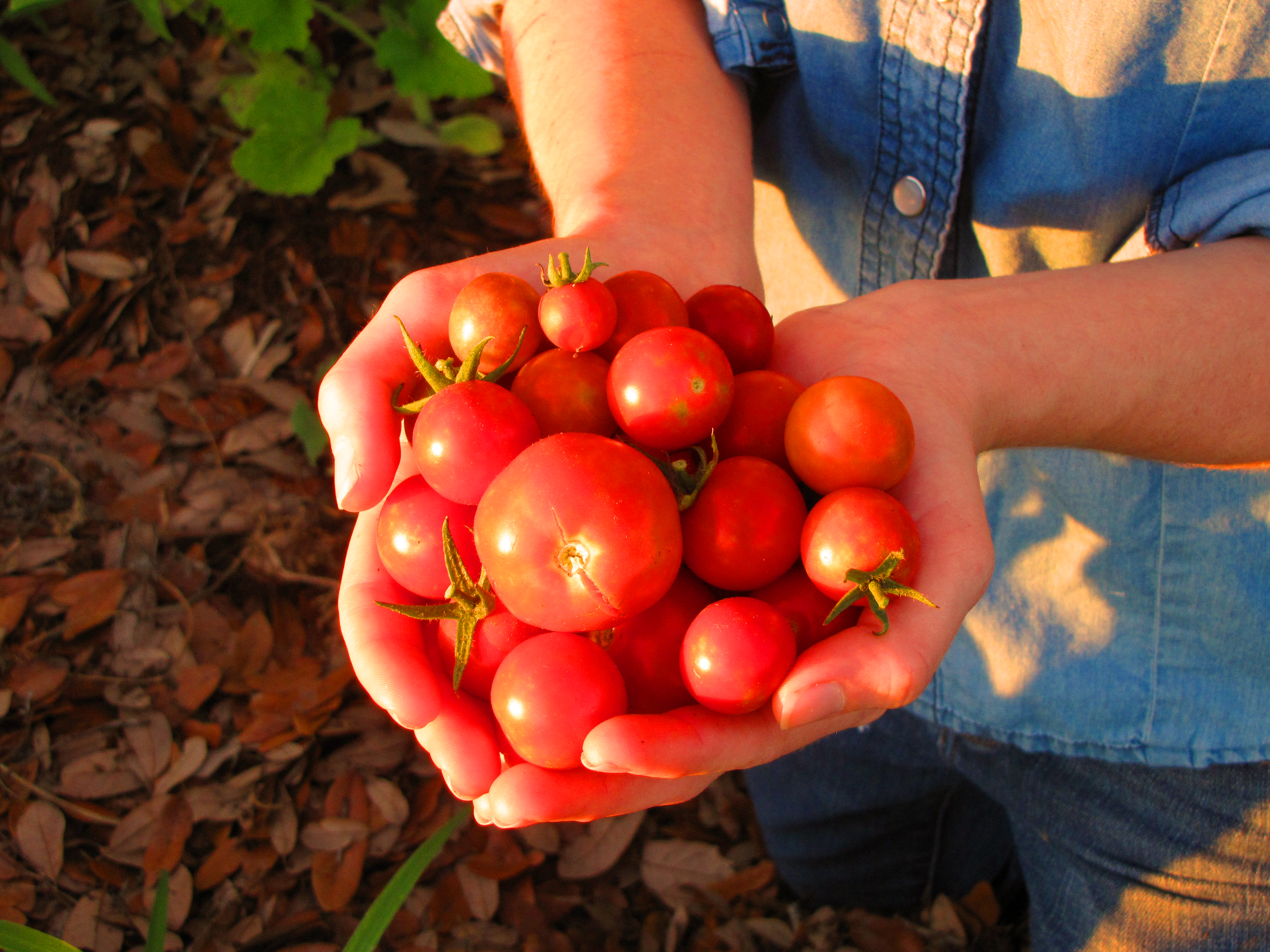
Farming methods can raise or lower the nutritional value of produce.  Planting techniques influence health.  We can see this by following a tomato through a large-scale conventional farm compared to a tomato grown in your own backyard garden.

On large-scale farms, tomatoes are fertilized with synthetic chemicals.  These chemicals cover the basic NPK requirements for plants, but often fail to replace the micronutrients that tomatoes demand from the soil.  In your garden, your own homemade compost builds healthy humus-rich soil that replenishes the full profile of vitamins and minerals that your plants require.  If the nutrients are not available in the soil, they can’t be taken up by the plant and delivered to the fruit.

On large-scale farms, growers select tomato varieties that ripen quickly and simultaneously for ease of machine harvesting.  These fast-growing varieties can actually outpace the ability of the plant’s root system to absorb nutrients from the soil.  Big farms also select for varieties that produce large, roughly square-shaped tomatoes.  These square-shaped tomatoes fit more easily into packing containers and thereby reduce transportation costs.  In your garden, tomato varieties are chosen primarily for health and flavor.

On large-scale farms, tomatoes are picked unripe, before vitamins, minerals, and lycopene are fully maximized in the fruit.  Once tomatoes are harvested, they stop absorbing lycopene.  Lycopene is an anti-oxidant, and we want the highest dose of this cancer-fighting compound in every bite of tomato.  In your garden, tomatoes are picked ripe and red on the vine with the maximum concentration of lycopene fully developed in the fruit.

Potassium is an essential mineral in plant health, and it is critical to human health as well.  The best way for people to get potassium is through their food, and the best way for plants to get this mineral is from the soil.

On large-scale farms, the plants themselves are treated with industrial applications of potassium.  In your garden, potassium and other minerals are added to the soil through compost and homemade wood ash—the ideal source for plants.

Moreover, the sweetness of a tomato—actually, the flavor of any fruit or vegetable—is the result of potassium.  Potassium molecules unlock the sugars in plants, and when more natural potassium is available in the soil, more sweetness develops in the fruit.

It is easy to taste the difference in your own ripe, red, freshly-picked tomatoes, but the differences in health are just as great, and just as important.  And your own garden is the perfect place to get the sweetest taste, and the greatest health, from your produce.

Radio Interview Today at 12:15pm

Friends, join me on the radio today at 12:15pm with host Liz Laubach.  The program airs on 90.3 FM in the Corpus Christi area and 90.7 FM in the Victoria area.

This month, our weekly radio broadcast, Your Wholesome Heritage Garden, is dedicated to nutrition.  Today, Liz and I will talk about the nutritional density of produce, and discuss how different farming techniques can raise or lower the health and flavor of your food.

Thank you for tuning in!

KEDT

Series on Nutritional Density

There have been a lot of changes to the American food supply in the last hundred years.

In 1901, the average American family spent 42% of their annual household income on food.  According to the Bureau of Labor Statistics, Americans spent more money on food than on housing, health care, or any other category.

Back then, local farms supplied most of the food people consumed.  Fruit was picked by hand at the peak of ripeness and delivered to town in horse-drawn carts.

Farmer Taking Produce to Town in San Ysidro, CA (photo courtesy sandiegohistory.org)

Farmer Taking Produce to Town in San Ysidro, CA (photo courtesy sandiegohistory.org)

The farmers of that day practiced traditional methods of agriculture:  they fertilized with manure, they used natural pesticides, and they selected for plants based on the taste and health components of the finished product.  The food these farms produced was extremely rich in vitamins, minerals, and cancer-fighting compounds.

However, those old-fashioned techniques did not scale up to the industrial demands of modern times.  The big farms of today apply harsh chemical fertilizers to the soil, and they demand plants that grow quickly, ripen simultaneously, and produce large brightly-colored fruit—the taste and health components are lesser priorities.  The unripe fruit is harvested by machines and loaded onto trucks, trains, and ships bound for markets all over the world.

Today, Americans spend less than 10% of their income on food, and we get a lot more food for the money.  However, the changes in farming methods that produced this amazing surplus of inexpensive food have come with a price.  The produce of today is not as rich in vitamins and minerals as the food our great-grandparents enjoyed.  In fact, one study showed that the nutritional density of produce has declined by more than 30% in the last fifty years alone.

Junk foods obviously add a lot of empty calories to the waistline of America.  However, health-conscious consumers who follow a diet of fresh fruits and vegetables are forced to eat 30% more calories to achieve the same level of nutrition.  And we are getting a dose of chemical pesticides in this food that our forefathers never had to worry about.

There is a growing demand among consumers to know more about the real nutritional value of their produce.  None of us want to go back to the food-scarce days of 1901, and we don’t want to spend more to eat well.  Consumers simply want good information.  Supermarkets typically score their produce based size, shape, and color, but finding the real score on nutritional density is not so easy.

In part two of this series, we will find out how specific changes in farming techniques can raise or lower the level of nutrition of our food.

Breaking Down a Tomato

The Importance of Phytochemicals

The Tapping Game

Kayla put my hand on the rounded side of her belly and held it there.  She was smiling and holding still, and said to wait for it.

Then she pushed in slightly with her fingers, three light taps, just above my hand.  There was a tap against my hand, from the inside.

She laughed and tapped again, and there was another tap from inside.

My astonishment at those first taps has been followed by many attempts, on my part, to get an answer from the little one.  She responds to my cues by shifting her weight inside of Kayla, or with kicks or light touches.  Sometimes she doesn’t answer, and I wait for long moments, and there is nothing.

The nights are cold now, and it is very cold in our room without a heater, and we can see our breath as we lay down for sleep.  Lying next to Kayla, nine months along, in the quiet dark, my hand on the tight skin of her belly, tapping, waiting for a reply, and drifting to sleep, the scene changes.  The new setting is from memory:  the inside of a tent on the ledge of a mountain.

It was too early in the year for that trip, and I knew it was risky, with winter still clinging to the mountains.  But it was the only time I could get off work, and I had the youthful confidence of one who does not know the true weight of snow.

It was a cross-country trek, a hundred miles through the back country, ten or twelve days if all went well, breaking brush through untouched forest, far from roads or trails.  The plan to was navigate the terrain below the snow line all the way to the river, then down a trail to a highway, then hitchhike back to my car.

It was several days into the hike–deep into the mountains, through towering forests with soft pine-needle floors, across steep ledges, alpine meadows, chest-burning ascents, the views opening up at the lower summits, a vertical white wall of barren 13,000 feet peaks to the front, the river somewhere in the unseen distance–when the blizzard came.

A dark wall of clouds rolled over the mountains and consumed me where I was hurriedly trying to descend to a lower altitude.  At first the sleet came at an angle, then turned to hard pellets of snow, then the sky went nearly black with snow and it did not stop coming down for two days.

It was difficult to walk in the slush after a short time, and impossible to see with the snow blowing like needles into my face, and as the powder created a new surface there was no way to know what was beneath each step on the white crust; solid ground, a fallen tree, a chasm twenty feet deep.  I found a windbreak on a ledge next to a boulder with a tall fir tree on each side, and set up the tent.

There was nothing to read in that tent, nothing to do but to conserve food and water, to freeze to the core, to toss and turn, to lay and think, my stormy history playing in my head, my dreams for the future shrinking to one or two very definite short term goals. The snow piled up continually with a weight to crush my tiny hollow space on the side of the mountain.

Finally, on the third morning, the sun rose and began to melt the snow.  After much miserable trudging, after sliding and tumbling in the knee-high slush, switching back and forth downward across snow-covered rocks and brush, the branches of trees dropping huge wet clumps in a bitter second snowfall, and descending finally into the green forest and the wet green grass, and at last down to the river, the water roaring and rushing over boulders and far above the banks, I was able to find a way back to the world.

But now, in this dream, I was back inside that tent on the side of the mountain, so dark at night I could not see my hands, and nearly as dark in the day, with the opaque light showing beige through the tent-walls, until the snow piled up again to create a new frozen darkness.

Except now, I was holding our baby, tiny, perfectly silent, but warm and alive and curling and uncurling against my chest.  I pulled her close and covered her in a fold of the sleeping bag.  We reached up together, feeling the smooth contours of the tent wall with our fingertips, watching our breath, my breath rushing out in big dissolving clouds, hers in short small bursts.

She pulled away from the tent walls.  She was afraid that the snow piling up on the roof would collapse and bury us.

I told her not to worry, that if we tapped on the tight skin of the tent, Kayla would reach down with fingers like the branches of a fir tree, and tap lightly from the other side.

I told her in the dream that everything would be okay; that we would find a way down from this mountain, down to the rushing river—that we would sleep soon in our own warm bed, covered in blankets, with Kayla looking down at us.