Gifts from an Eastern Garden

Boswellia Tree (photo courtesy themostbeautifulthing.com)

Boswellia Tree (photo courtesy themostbeautifulthing.com)

We know the story of the Magi, the wise men bearing gifts, from the historical record, from outside of the Bible.  It was a documented journey with many of the details unclear, and only the main crux of the story handed down to us.

We know from history that a real-life baby was born in Bethlehem, during the Roman census, to impoverished parents; and that real men, great learned men, traveled from Persia and further east to pay tribute to this child.

King Herod intercepted these Magi for questioning, and they explained to Herod that each of them, in their widely scattered lands, had shared an identical dream.  They were told to follow a star to the birth of a child, for this child would become king.

And we know that later, based on this testimony, Herod ordered the murder of all the male children of Bethlehem to ensure that this particular child would never grow up.

The tribute these wise men brought was frankincense and myrrh.  Frankincense comes from Boswellia trees, and myrrh from Commiphora trees.  Deep cuts are hacked into the bark of these trees, and resin oozes from the wounds.  The resin forms tear-shaped drops, at the cuts, and these drops of resin are removed to process into the finished product.

Frankincense Resin (photo courtesy yullysebayang.wordpress.com)

Frankincense Resin (photo courtesy yullysebayang.wordpress.com)

Frankincense was very rare; it was a balm and a sacred oil.  Myrrh was a fragrant perfume, and was also used as an embalming fluid.

The trees that make this product are tough and resilient; they grow in the thinnest of desert soils, and even into the sides of rocky cliffs.  They are not killed by their cuts, but instead they grow back from the cut places.  They regenerate from their wounds.

These gifts were powerful symbols to place at the feet of a child–a foreshadowing of the scars and the pain that loomed in the future of this newborn baby.

It was the most momentous birth in the history of the world, but no one at the time understood this—no one except these Magi.  These learned men walked all the way from Persia and further east, an incredible journey of faith, chasing a star across the desert, until they came to a stable on the outskirts of Bethlehem.

They walked into the stable where a new mother sat among the animals, and these great men knelt down in the dirt and prostrated themselves before the child, the King of Kings, and they worshipped him.  They brought their most precious gifts to present to their new Lord, frankincense and myrrh, gifts they had harvested from their own gardens.

The Changing Lanes of the Sun

A Winter Sunrise (photograph courtesy Al Past, author of Distant Cousin and other novels)

A Winter Sunrise (photograph courtesy Al Past, author of Distant Cousin and other novels)

In South Texas, we get plenty of sunshine—more than enough, even in winter, to grow a lush and vibrant garden.  Ironically, insufficient sunlight can be a problem in many South Texas gardens.

The problem is not a lack of sun, but rather too much shade over the garden.   Thomas Jefferson said that “under the constant, beaming, almost vertical sun of Virginia,  shade is our Elysium.”  And Virginia has nothing compared to the burning heat of a South Texas summer sun.  We adore the shade, and a lawn without shade can be a miserable place.

However, trees, fences, houses and other structures around your vegetable garden can get in the way of the light.  And because of the changing lanes of the sun, a garden that gets enough light during the summer may be shaded out during the winter.

The Changing Path of Sun  Diagram Courtesy Solar Choice

The Changing Path of Sun
Diagram Courtesy Solar Choice

The sun, over the course of the year, travels through different paths in the sky.  On the spring equinox, in March, the sun rises exactly in the east, and sets exactly in the west, and the hours of day and night are equal. Then, through the summer, the sun moves a full 23.5 degrees north of its line at the equinox.  There are more hours of sunlight during the summer, and the sun shines at a more direct angle over the garden.

The sun then crosses back over the line of the equinox and moves another 23.5 degrees south for the winter solstice.

The Changing Angle of the Sun can Create More Shade During Winter if there are Trees and Structures on the South Side of the Garden (Diagram Courtesy DOE)

The Changing Angle of the Sun can Create More Shade During Winter if there are Trees and Structures on the South Side of the Garden (Diagram Courtesy DOE)

The winter solstice is today, Saturday, December 21st.  Today, we will have the fewest hours of daylight all year, and the sun will travel through its southern-most lane, its lowest angle in the sky.

The movement of the sun from the winter to the summer solstice represents a full 47 degrees of change each year.  You can measure this remarkable shift of sunlight by standing in your garden today and memorizing the exact points on the horizon where the sun rises and sets.  Then, do the same thing on the spring equinox and once again during the summer solstice.

Farming societies have been intimately familiar with these movements of the sun since ancient times, and it is interesting and helpful in modern times to know these angles of the sun.

A garden should receive at least eight hours of sunlight each day.  A few hours of direct sun at noon, and dappled shade in the morning and evening, is probably not enough light for good photosynthesis.

Insufficient sunlight leads to weak anemic plants that are highly susceptible to disease and insect damage.  Or, your plants, without enough sun, may slowly grow to full size, but produce very little fruit.  Adding fertilizer and pesticide will not help a garden that doesn’t get enough sun.

Today, the winter solstice, the shortest day of the year, is a great time to study the relationship between the light and your garden, to make sure you are getting the most from the winter sun.

(The following sunrises and sunsets were captured by Al Past, a linguistics professor, photographer, and author of the wonderful Distant Cousin novels.)

Sunrises and Sunsets Al Past 2 Sunrises and Sunsets Al Past 3 Sunrises and Sunsets Al Past 5 Sunrises and Sunsets Al Past 6 Sunrises and Sunsets Al Past 7

A Popular Ham Roast

Slice ham or shred for "pulled pork"

Slice ham or shred for “pulled pork”

For the last few years, our ham roast recipe has been the number one ham roast recipe on the internet.

If you performed a Google, Bing, or Yahoo search for “ham roast recipe” or one of many variations on ham, Four String Farm would appear at the top.

In the case of Google, that was first out of more than 7,200,000 results; and for Bing, first of 16,600,000 results.

We didn’t do anything to promote this recipe.  We simply posted it a few years ago, along with an article called Ham is for Luck on New Year’s Day, and the recipe took off.  Incidentally, the article about why ham is lucky on New Year’s Day also ranks very high in searches on this topic.

Since that first ham roast recipe, we have developed numerous other wonderful recipes to cook our hams, including this variation by our friend Kimmi.  However, once a site becomes popular on the search engines, it sort of takes on a momentum of its own.

Now, it turns out that Paula Deen, that honey-voiced maven of Southern Cooking, has taken over first place in hams!  Martha Stewart and her famous hams are still in the running but trailing behind.  We are very honored to be in the search engine company of the likes of Paula Deen and Martha Stewart!

This recipe is popular because more and more people want to know about chemical-free free food, and how to get back to wholesome cooking.  They want to know why wholesome food tastes so much better than inferior conventional products.  Because of our ham recipe, our web site has received tens of thousands of hits from people looking for a recipe, or who are interested in pastured pork, or have questions or information to share with us.

Additionally, I have had requests from folks all over the country, from California to Vermont, asking us to ship them one of our pastured ham roasts.  However, we do not sell our food in this way.  I ask these folks to take the time to find a local farmer who produces chemical-free food, and to shop with that farmer.  Both the farmer and the customer will benefit from that relationship, and the customer will enjoy a continual supply of fresh, delicious, wholesome food.

In South Texas, you can only get your pastured hams from Coastal Bend Health Foods in Rockport.  And Kimmi is offering these beautiful hams for 10% off between now and the New Year.

And please note, we now have new packaging for our pork roasts, ribs, bacon, and ground pork.  We have switched to this superior grade of vacuum packaging to lock in the freshness and to better protect the product.

I invite you stop by Kimmi’s store soon to pick up your ham and to shop for your Christmas and New Year’s dinner.  Kimmi has some recipe ideas for you.  But of course, you can always Google search a popular recipe!

Girls Have China

Kayla and I attended a marriage and family seminar at the Baptist Church in Corpus Christi.  The preacher who led the class said the main thing to know about children is that you have to talk straight to them about ‘the business’.

He said to never use cute names for body parts, and not to use pseudonyms for the birds and the bees, which only causes confusion, and creates trouble later on.  Especially with daughters, he said, dads must have the courage to tell it straight.

So, our little girl, at five years old, while we were all sitting at the table, surprised us with some awkward anatomical questions.  I graciously yielded the floor to Kayla so they could have ‘the discussion’, and I went outside for some pressing work that couldn’t wait another moment, like making sure the grass was still growing.

Later that evening, the little one came and sat down next me on the couch and gave me a serious look.  She said she had something important to tell me.

“Yes, ma’am?” I said.

“Daddy, girls have China.”

“Girls have what?” I said.

“Girls have China,” she said.  “I know all about it.”

I knew that Kayla had taught her the proper anatomical names, like the preacher told us to do.  The little one had obviously misunderstood the terms, and it was up to me to straighten it out.

“That’s right,” I said.  “Girls have China.  And do you know what they have in China?”

“No, what?”

“In China, they have big cuddly koala bears!” I said.

“Oh, I love koala bears, they are so cute!” she said.  “What else do they have in China?”

“In China, they have big cuddly koala bears and soft fluffy white tigers and really good Chinese food.”

“Oh Daddy!  I love all of those things!” she said.

“That’s right, so always remember, girls have China, and boys have Africa,” I said, hoping to take the discussion in a different direction.

“Daddy,” she said, “that’s not right.  Boys don’t have Africa.”

“They don’t?  What do boys have?”

“Girls have China and boys have peanuts,” she said.

“That’s right!  Boys have peanuts!  And you know that you are really, really allergic to peanuts, right?”

“I am?” she said.

“Yes, you are now,” I said.  “Really allergic.  You will be allergic to peanuts until you are 30 years old.  Got it?”

The Scent of a Radish

A Harvest of Radishes

A Harvest of Radishes

Freshly-picked radishes can be spicy, sweet, flavorful, and delicious.  Unfortunately, the all-you-can-eat salad bars of the 1980’s ruined radishes for most of us.   But even if you don’t like to eat them, radishes can play an important role in your garden.

Radishes were first cultivated in China, and they were carried along the ancient Silk Road to Rome, and then northward throughout Europe.  The Conquistadors and the Pilgrims brought radishes to the New World in the holds of their ships, and pioneer settlers carried them west.  I first learned the value of radishes in the lush gardens of Japan, where daikon is a dietary staple.

Radishes for Pest Control

On our farm, we grow radishes primarily for pest control.  The scent of a radish repels and confuses pest insects.  To protect your delicate winter greens from bugs, companion plant a variety of radishes liberally throughout the garden.

You can also plant a thick line of radishes across the width of your garden beds every few feet down the rows.  Plant your greens and carrots and broccoli right up to the line of radishes on either side.  The radishes will form walls, or barriers, to trap insects into confined areas, where they are easier to eliminate.

Whether you need to remove your bad bugs by hand (the pinch method), or spray them with Bt (a natural treatment for caterpillars), pests are easier to find and do less damage when they are confined in your radish “bug traps”.  Also, beneficial predators seem to have an easier time hunting pests when they are trapped in confined areas.

Purple Radish Flowers

Purple Radish Flowers

Bees and Beneficial Predators

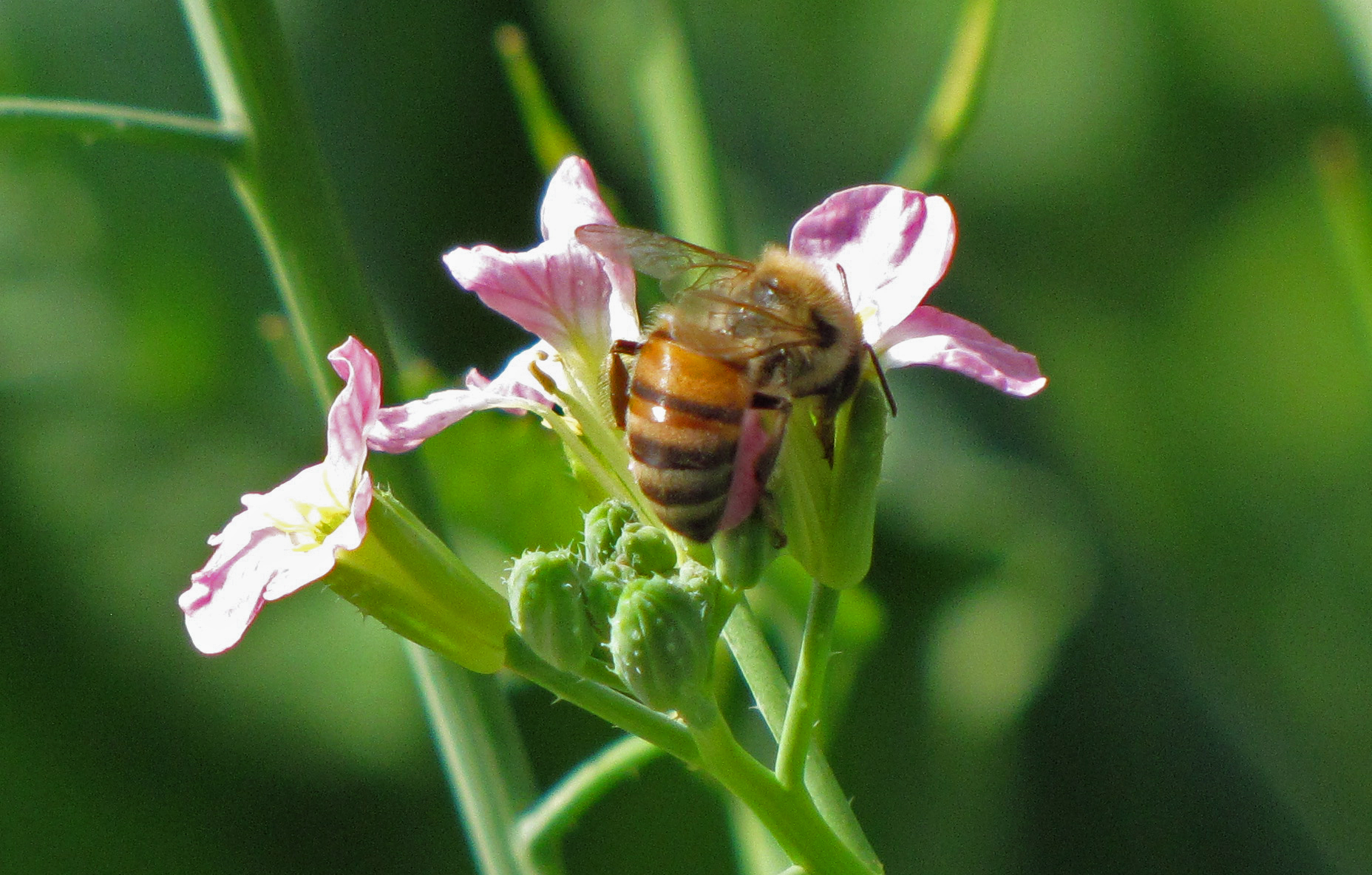
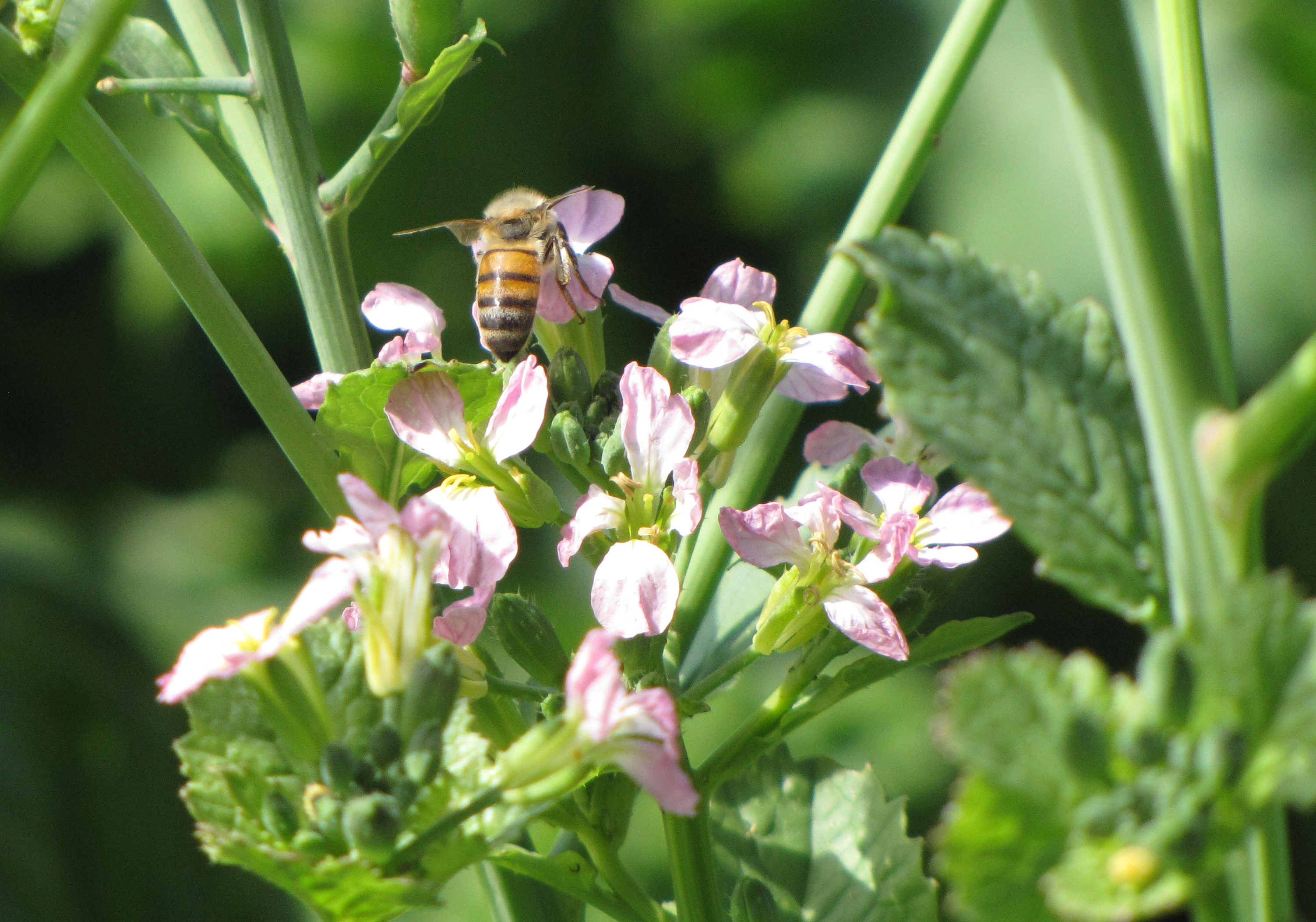
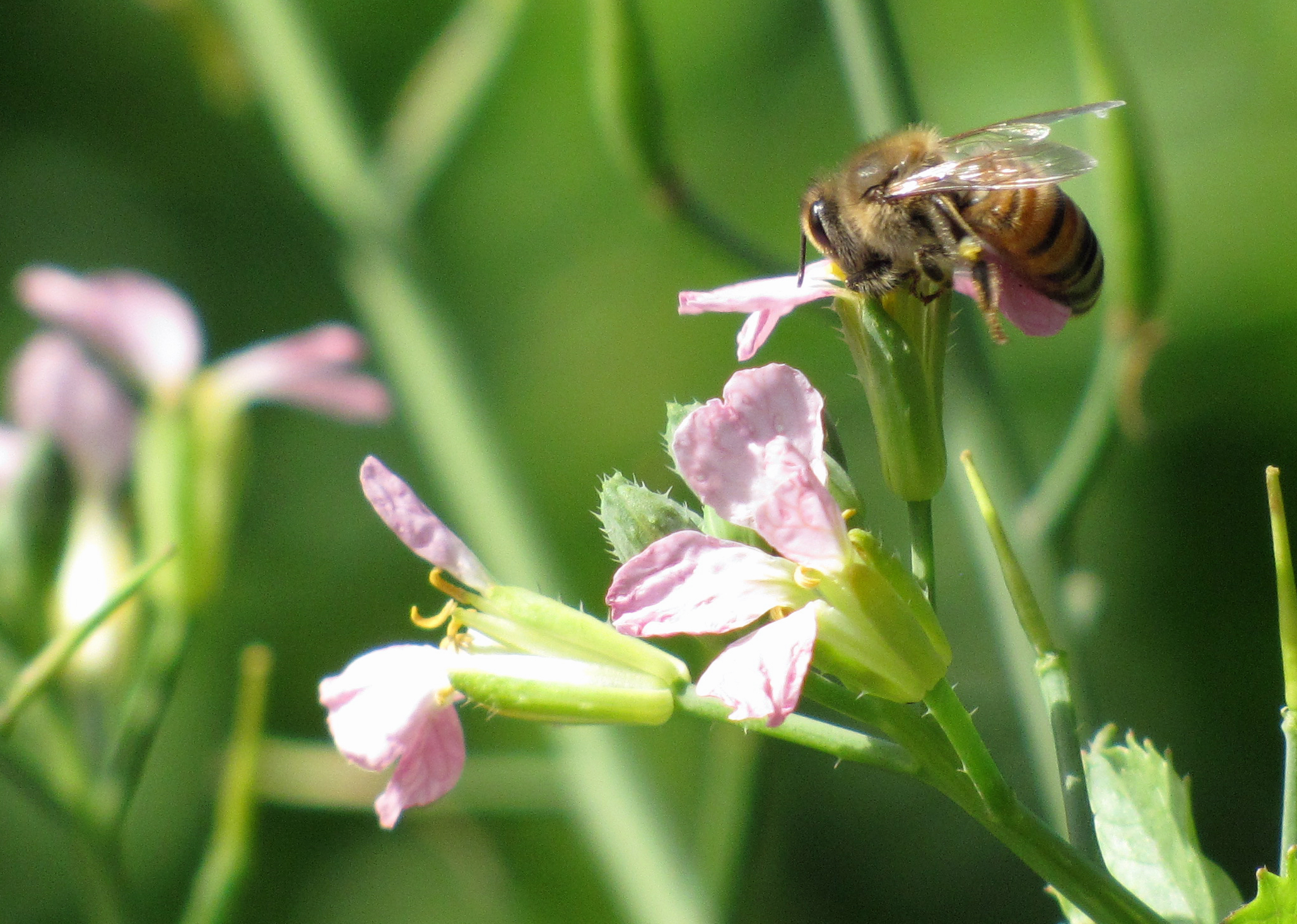
Mature radish plants offer a brilliant display of pink, purple, and white flowers, and radishes are the one plant we can count on to flower in the coldest weather, even when they are covered with frost.  The flowers serve as a beacon to draw bees and beneficial predators into the garden, especially when they are the only flowers blooming in the bleak winter landscape.

Radish, Bee Drinking

Radish with Bee Above

Radish with bee buzzing

Radish with Bee Pollinating

Radishes Help Chickens Make Delicious and Nutritious Eggs

If you leave them in the ground long enough, radish roots can grow up to ten or fifteen pounds.  I harvest these huge bushy radishes and feed them to our laying hens, and the hens devour them, root, stalk, and all.  Radishes are an inexpensive and highly nutritious food source for our chickens during the winter, when green material is scarce—and radishes help chickens produce exquisitely delicious eggs.

Laying Hens Enjoying Radishes

Laying Hens Enjoying Radishes

Varieties of Radishes

The standard varieties for radishes are cherry bell, scarlet globe, white icicle, sparkler white tip, and long scarlet, but there are dozens of varieties to choose from.  Plant as many different types as you can find, because different varieties are better at resisting different types of pests, and you might even find some tasty radishes that you like to eat.

Daikon is a Japanese radish with a wonderful flavor, and there are many exotic radish varieties from the Orient with incredible flavor.  The quicker you harvest radishes once they mature, the sweeter the flavor; and the longer you leave them in the ground, the hotter and more pungent they become.  I realize that with radishes “sweet” is a relative term–not sweet compared to chocolate bars and strawberry sodas, but sweet enough when they are the first taste of out your winter garden.

Kimmi of Coastal Bend Health Foods with a Bunch of Radishes

Kimmi of Coastal Bend Health Foods with a Bunch of Radishes

Eating and Cooking Radishes

Every part of a radish plant is edible, and the flowers are a unique delicacy.  Shake the radish plant over a bowl to catch the flowers, and sprinkle them on salads and meat dishes.  Radish roots are best pickled or roasted with other root vegetables, like carrots and parsnips.

Successively Planting Summer Vegetables with Radishes

If you plant radishes now, in mid-December, they will be ready just after the New Year, and the scent of your radishes will protect the garden for the rest of the winter.

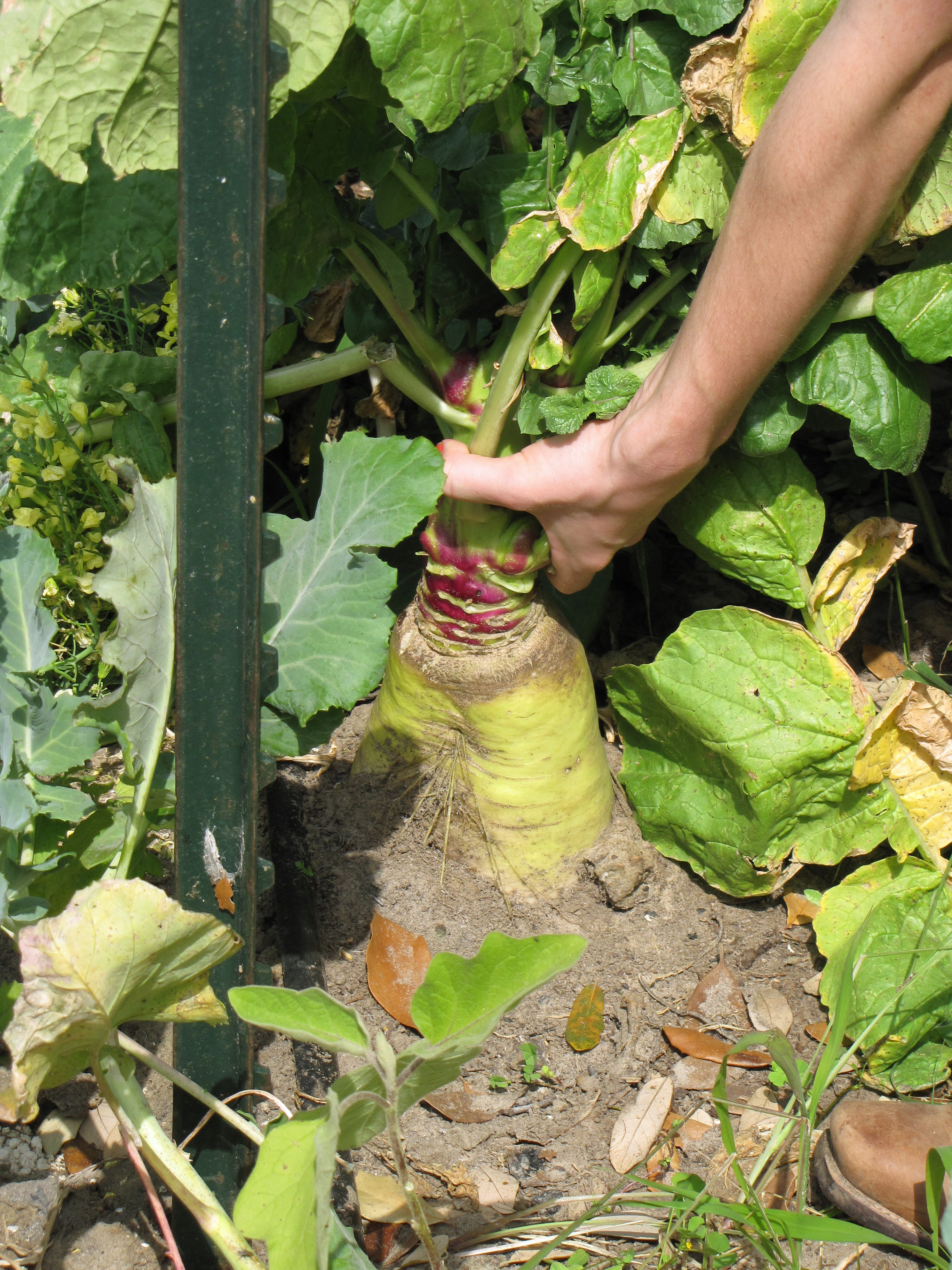
On the first day of March, when your radishes are dripping with fragrant flowers, pull them out of the ground, and simply drop your tomato, eggplant, and pepper transplants into the open holes.  Cover the new transplants with compost, and keep your garden going through the spring and summer.

Pull this 15 lb radish, feed it to the chickens, and plant a tomato in its place.  Notice the T-post for the tomato trellis is already in the ground.  We put the posts in when we plant the winter garden, so it is easier to transition it to a summer garden later on.

Pull this 15 lb radish, feed it to the chickens, and plant a tomato in its place. Notice the T-post for the tomato trellis is already in the ground. We put the posts in when we plant the winter garden, so it is easier to transition it to a summer garden later on.

Eight Months Along

Kayla Pregnant 36 weeks 12-5-13

Kayla and I had an appointment yesterday to have family pictures taken on our farm, but while we were waiting for the photographer to arrive, this winter storm blew in.

The temperature dropped from 70 degrees to 40 degrees in about an hour, and the sky turned dark and gray.  We had to reschedule with the photographer for next week, when, hopefully, there will be more sunshine and less cold wind.

But I had already dragged our fancy green chair out to a pasture, and Kayla had her red pants on, so I went back to the house for my camera.  Emma may want to look at this someday.  I took these pictures of Kayla, eight months pregnant, as the last of the charcoal light drained from the sky.

Kayla Pregnant by Lake 12-5-13Kayla Pregnant in Chair 12-5-13

The Story of Crisco

Lard Ad from 1916.

Lard Ad from 1916.

In the early 1900’s, there was a tin pail of lard in nearly every kitchen in America.  Lard was the universal shortening.

The demise of lard began in 1906, when Upton Sinclair published his book, The Jungle, which exposed the gruesome reality of the Chicago meat-packing plants.  Sinclair claimed that workers would sometimes fall into the boiling vats of lard and became part of the product.

The Jungle was a work of fiction, and President Teddy Roosevelt called Sinclair a “crackpot” who was “hysterical, unbalanced, and untruthful.”  Nevertheless, Sinclair set the stage for a bold new competitor to lard.

Around this time, William Proctor and James Gamble realized that the rise of electric lighting was about to put their candle-making company out of business.  But Proctor and Gamble made a key scientific breakthrough:  they discovered that hydrogenating the process to make their cottonseed oil candles would turn the candles into a white, lard-like substance.  They called this invention Crisco vegetable shortening (the vegetable was cotton).

Proctor and Gamble launched Crisco in one of the brilliant marketing campaigns of the 20th Century.  P&G positioned Crisco as a new type of food, clean and pure, a product of science, healthier and safer than lard.

Crisco, The Story of CriscoIn 1912, P&G released a beautifully-written and gorgeously-illustrated cookbook with hundreds of recipes using Crisco.  This cookbook, The Story of Crisco, was printed in numerous languages to target niche ethnic markets.  Jewish homemakers in particular were early adopters of Crisco as a kosher product.

P&G gave away the cookbook with their product and mailed it all over America, which was a very big deal at the time.  The Story of Crisco was treasured by early 20th Century homemakers and stands to this day as a monument to food marketing genius.

P&G paid celebrity chefs to lead cooking classes featuring Crisco to establish the credibility of the brand.  The company claimed in advertising that Crisco would instill good moral character in children.  They paid scientists to produce research that supported their health claims.  Crisco hammered away at the health theme for decades.

Crisco was a pioneer of print media during WWI, radio in the 1920’s, and television in the 1930’s.  The dual marketing strategy was to promote the purity of Crisco while subtly undermining lard.

The lard industry, controlled by a consortium of good old boys, mistakenly believed they held an eternal monopoly on shortening.  Lard industry leaders failed to recognize the threat from Crisco in time, or to successfully defend and promote their product.  Lard was demonized to the extent that even today the word lard itself invites disgust.  Eventually, Crisco completely replaced lard in the kitchens of America.

Crisco’s product health claims were seriously challenged in the 1990’s when scientists revealed the truth about trans fats.  Despite numerous product reformulations, Proctor and Gamble divested itself from the Crisco brand in 2001.

The Crisco campaign of the 20th Century was enormously effective in shaping attitudes and beliefs among consumers.  Lard, a wholesome product that had been loved by Americans for centuries, was utterly destroyed in the marketing arena by an imitation food that was created in a lab and manufactured from cotton.

Modern food companies are even more sophisticated and more effective in their food marketing messages.  We are bombarded constantly with these highly compelling messages.

As a consumer, it can be difficult to know what to believe, to know the real story behind the advertising.  But the closer we eat to home, to local farms, and to our own backyard gardens, the easier it is to know the truth about our food.

(I found the following vintage advertisements for lard on the site ecofriendlyfreckles.com.   It is no wonder lard lost the advertising war!)

Lard, a happy family (newsblaze)

All You Need is a (LARGE) Spoonful!

All You Need is a (LARGE) Spoonful!


The Three Sisters at the First Thanksgiving

Pilgrims Landing on the Beach (picture courtesy Fine Art America)

Pilgrims Landing on the Beach (picture courtesy Fine Art America)

When the Pilgrims reached the shore of America in the winter of 1620, they stepped into a harsh and desolate landscape.  The site of their future colony was a rocky windswept beach rising up to a dark and forbidding forest.  The Pilgrims knew they must somehow grow crops on this rugged land, and quickly, if they hoped to survive.

The Pilgrims were not experienced farmers, and this was unfamiliar soil and climate.  They had no draft animals to pull a plow, and only a few simple tools to break the ground.

However, despite these shortcomings, by the following fall, the Pilgrims had grown enough vegetables to hold a three day feast, the First Thanksgiving, to thank God for their bounty.  They had even preserved enough food to last them another six months.

So, how did the Pilgrims accomplish this remarkable feat of agriculture? 

The familiar legend tells how the Indian Squanto taught the Pilgrims to plant corn with fish buried beneath as fertilizer.  However, that is not the complete story.  If the Pilgrims had simply planted a straight-row monoculture of corn, the crop very likely would have failed.

What Squanto actually taught the Pilgrims was how to plant corn, beans, and squash together, in a companion planting technique called the Three Sisters.  It was Three Sisters gardens that produced such a bounty of vegetables for the Pilgrims.

The Three Sisters are corn, beans, and squash planted in intensive companion gardens.  The bean vines climb up the corn stalks as a trellis, and the squash and pumpkin plants cover the soil as living green mulch.

Beans are a nitrogen fixer; they fertilize the corn as they grow.  The squash leaves choke out weeds, keep the soil cool and moist, and provide a sanctuary for beneficial predators.  The gardens are dense and lush, and the plants ripen in continual successive waves.

Of particular importance to Pilgrim and Indian farmers, corn, beans, and squash are highly nutritious.  When eaten together, the Three Sisters are a complete and balanced meal, rich in carbohydrates, protein, vitamins, and minerals.  And these foods store well for long periods of time.

Incidentally, the Pilgrims also planted gardens their first year with seeds they had brought from England:  barley, peas, and parsnips.  But, according to William Bradford, those Old World crops were a dismal failure.

Following the First Thanksgiving, each Pilgrim family was given their own plot of land to farm, and corn, beans, and, squash constituted up to 70% of the Pilgrim’s diet as the colony grew.  Three Sister gardens continued to be planted extensively throughout North America, until the early 20th Century, when industrial farm equipment replaced small-scale farmers, and the old ways of farming were forgotten.

However, we modern gardeners can take a lesson from that First Thanksgiving.  Three Sisters gardens work just as well today as they did for the Pilgrims 400 years ago.

The Circadian Rhythm of Plants

Sunset in the Garden

Sunset in the Garden

Scientists have announced a fascinating discovery about the secret life of plants.  It turns out that plants are governed by circadian rhythms, just like people.  And the circadian rhythm operates in plants even after they are harvested—even while the plants are sitting in warehouses, on grocery store shelves, or in your refrigerator.

And not only that, scientists have learned that circadian rhythms have a significant impact on the nutritional value of the plants we eat.

In plants, just as in people, circadian rhythms are endogenous, which means they originate in the cellular memory of the individual.  Our personal circadian rhythms are programmed into our DNA.  Circadian rhythms are also heavily influenced by environmental factors, such as day and night, and the rhythm can be altered with changes in the light/dark cycle.

The peak of a plant’s circadian rhythm is in the afternoon, when plants most require energy to fight heat stress and protect themselves from insect attacks.  The low ebb of the circadian rhythm for plants is the middle of the night, the same as in people.

In the recent study, scientists observed how the circadian rhythm affected the concentration of glucosinolates in plants.  Glucosinolates are compounds produced by plants to strip toxic substances from their cells.  In humans, glucosinolates are cancer-fighting agents that remove carcinogens from our bodies.  To do the most good for our health, we want to eat produce with the highest concentration of glucosinolates in every bite.

Scientists manipulated the light/dark cycle for certain plants to produce 12 hours of light and 12 hours darkness, to simulate the day and night conditions of plants in the field.  They found that plants achieved their highest concentration of glucosinolates during the afternoon, when the plants were at the peak of their circadian rhythm.

In fact, the concentration of these cancer-fighting compounds was twice as high during the afternoon compared to the middle of the night, when the plants were at the low ebb of their circadian rhythm.

It is remarkable to consider how much the nutritional density of plants can fluctuate in twelve hours simply due to changes in light.  And the circadian rhythm is only one of many factors that influence the health and taste of produce.

Scientists continue to learn new information about the nutritional density of our food.  Plants are living matter–living energy–even after the plants are harvested.  This living energy fuels our work, our growth, our wellness, our busy lives.  The quality of the plants, and the quality of the potential nutrition of the food, depends largely upon how it is grown.

To get the most nutritional density from your produce, harvest it fresh from your own garden or buy it from a source that offers locally grown and freshly picked vegetables.  Thanks to scientists, we now know that we can enjoy our produce not only at the peak of ripeness, but also at the top of the circadian rhythm, as well.

Planting by the Phases of the Moon

Full Moon over Four String Farm

Full Moon over Four String Farm

For most of human history, farmers have looked to the night sky, to the phases of the moon, to know when to plant their fields.

The Ancient Egyptians planted their crops in the rich sediment of the Nile Delta according to the phases of the moon.  The great Roman historian, Pliny the Elder, wrote about the moon’s extensive influence over Roman agriculture.

In Africa, China, and the far reaches of the frozen north, areas developing separately and in complete isolation, the moon governed planting cycles.  The Mayan Indians, long before they were reached by Spanish Conquistadores, planted their gardens by the phases of the moon.

Benjamin Franklin published the lunar calendar in Poor Richard’s Almanac to help Colonial farmers plan their plantings.  Our Founding Fathers followed the phases of the moon in their gardens.

In modern times, some folks say planting by the moon is folklore, but some farmers swear by it.  On our farm, we plant by the lunar cycle when possible, but usually we are happy to get our seeds into the ground any time our busy schedule allows.

The fact is, seeds will grow perfectly well any time of the month they are planted.  But if you want to know more about how to capitalize on the magnetic and gravitational impact of the moon on your garden, agricultural scholars Alan Chadwick and John Jeavons offer some insights.  Here is what they tell us:

Alan Chadwick and John Jeavons, courtesy Grow Bio-Intensive

Alan Chadwick and John Jeavons, courtesy Grow Bio-Intensive

The new moon is the first day of the lunar cycle.  When the moon is new, or dark, it exerts a strong gravitational pull on the earth, and tides are high.  The groundwater level beneath the soil is lifted the same way tides are lifted, and in this gravitational pull the roots of plants experience a growth spurt.

The new moon, or dark moon, is the best time of the month to plant short germinating seeds and extra-long germinating seeds.  Short-germinating seeds sprout in one to seven days.  Most garden vegetables are considered short-germinating.  Extra-long germinating seeds sprout in seven to twenty-one days.  Eggplant, peppers, and parsley are extra-long germinating seeds.

During the first week of the lunar cycle, plants experience a balanced rate of growth between the roots and the leaves.

However, during the second week of the lunar cycle, as the moon becomes full, the leaves of the plants grow at a rapid rate in the bright moonlight.  The leaves grow at a faster rate than the roots, which set down strong legs during the first week of the lunar cycle to allow the plant to “reach to sky” during the full moon.

The full moon is the best time to plant long-germinating seeds, which take eight to twenty-one days to sprout, such as basil, okra, and parsnips.  The full moon is also the best time to plant your transplants into the garden.

The third week of the lunar cycle, as the moon is waning and gravitation pull strengthens, plant roots experience another growth spurt, while leaf growth remains relatively static.

Finally, during the last seven days of the lunar cycle, as the moon goes dark and gravitation pull falls away, plants experience a time of balanced rest, where the rate of growth slows in both roots and leaves, and then a new lunar cycle begins.

In North America, the next new moon, or dark moon, occurs this Sunday.  You certainly don’t have to plant your seeds by the lunar cycle to be successful.  But if you do, you can feel reassured knowing you are backed by thousands of years of gardening tradition.